Author Archives: Jeff Allen

Unknown's avatar

About Jeff Allen

A professor and scholar of wisdom

Connecting Learning to Performance

Effective Training in Four Easy Steps


“Those who can do . . .those who can’t teach.” How many times have I hear that one? Never!

Teaching seems easy, until you have 40 students looking to you for “the information” that they want and need. Twenty-five years of teaching, and twenty years of teaching teachers,  has taught me that there are easier choices in life.   But few more rewarding!

Martial artist, soldier, ironworkers, police officers and other professionals enter the teaching/training field because someone thought enough of their previous experience to give them a chance.   Teachers/trainers stay in the professions because others value their information. The teachers/trainers that you personally remember in life valued the profession enough to not only train in their subject matter content area, but also in the delivery of the information.

The teaching methodology shown here today is based on the 4MAT system. This teaching system is well research and accommodates all learners.   The theoretical underpinning are solid, the method is simple.   What more can a teacher/trainer desire in a teaching methodology?

In this methodology, we “move around the clock” beginning at 12 o’clock:

WHY?

It never fails a student interrupts my happy thoughts and ask, Why do I need to learn this?   The question that they are really wanting to ask: Why did you waste a valuable portion of my life teaching me this #)@&%)& stuff when I’m never going to encounter it outside of your made-up world.   Ah, the joys of teaching. Why fight it?

Screen Shot 2017-01-05 at 2.42.27 PM.png

First, and always, answer this basic question of yourself: Why am I teaching this to my student? The best strategy I have found to answering this question is to act as a motivator/witness/storyteller.   In the first step, tell a story; describe an instance that happened to you, happened to someone else, or an instance that might happen. Do your research. This provides a context for learning.   The learner can then answer the “Why?” question for themselves and can begin to learn from you without THE nagging question. As much as people say they want “THE ANSWER”, they always are ready for a good story!

WHAT?

You’ve now setup the student for learning. The next step is to provide the answers. The teacher/trainer is most comfortable delivering information. In technical training, the instructor has two types of information to provide: background information/theory and step-by step instructions. The instructor’s role in this step is simply as a teacher.   In step-by-step instruction, deliver one method for accomplishing the task at a time. This step provides students an opportunity to see the methodology modeled correctly.   If all learners understand the method provided, it is then time to provide optional steps as appropriate.

HOW?

This step is easy! Practice! Practice! Practice!

Provide your students the opportunity to practice the methodology that is you have taught to them.   Your role is as coach/skilled-guide. All of us learn through trial and error.   It is now the student’s turn to take over the classroom responsibilities. Coaching good … Teaching bad.   It is the teacher’s job to fade into the background an only come out when their skilled opinion is needed.

Explore?

Let students teach it to themselves. In this step, the teacher is reliant on self-discovery.   The teacher’s role is now transformed into an evaluator/remediator. This step is VERY often left out in the learning process and is the very important. Your clock is not yet complete without this step. In this step the teacher allows students to explore the newly taught materials. I personally learn a lot when student are exploring techniques.

In this step, the teacher is the person that then gets to ask “Why?”. This is a pleasant role reversal for the teacher and many students begin to better understand the learning process.

  The Cycle

But, I don’t have time to do this in my training…you ask too much! Of course you have enough time!   The time spent in each step is not important (10 seconds, 1 minute, 10 minutes). The fact that you have spent some time on each step is important.   I find that this process is largely subconscious in outstanding instructors.   Each of these steps should be used for every instructional session. Move around the clock with the four step and enjoy effective instruction.


Resilient: WPC — Travels and Trifles

“Inside of a ring or out, ain’t nothing wrong with going down. It’s staying down that’s wrong.” Muhammad Ali Search the web for quotes about resilience and you’ll find hundreds of examples of great minds expounding on the subject. For me it was the quote by Muhammad Ali that really hit home (pun intended). Somehow […]

via Resilient: WPC — Travels and Trifles

Austin 70.3 Relay (bike leg)

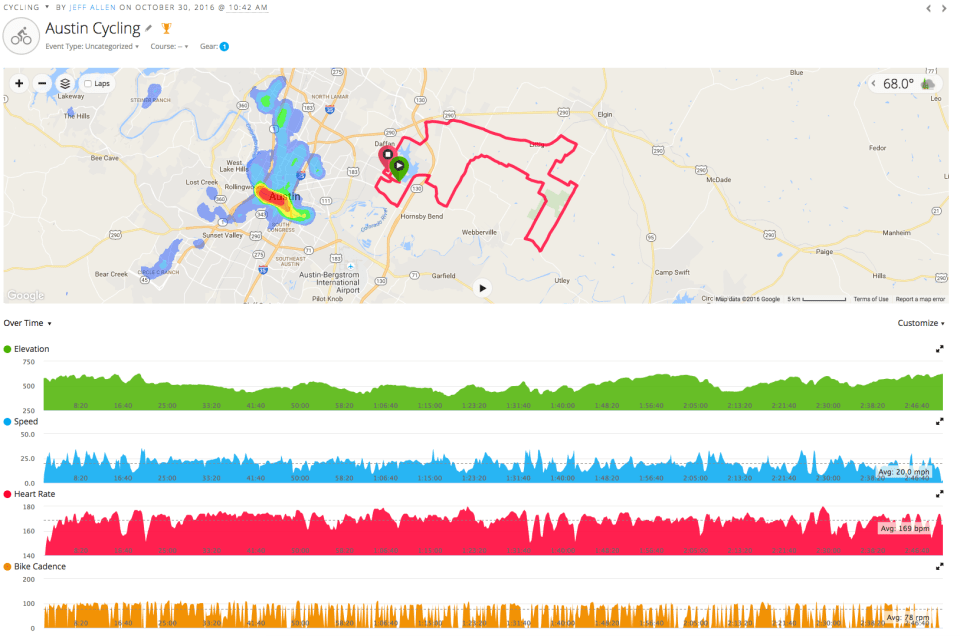
This race report is a little bit different than others since it’s not truly a race report, but self-feedback on a single leg of a race.  Additionally, there was no swim leg….so it was a walking start to the line, mount and ride.  However, I think you’ll find something useful with the information.  This race report was especially useful (in hindsight for my Dallas Marathon on December 11, 2016):

The Problems

  • Cramping – not hunger / bonk. My hypothesis is that it was an electrolyte problem, rather than a food problem.   1 bananas consumed hour before start of bike.   Felt good about my food prior to the start of the bike.
  • Average HR of 169, high 181. Zone 5 95% of time, Zone 4 5% of time. This is an overall fitness problem, but will improve naturally.
  • Don’t like the higher HR, but the goal was to “hammer” and reach 20mph average (successful).
  • Cramping at 45 mile marker:   QUAD cramping.   Gotta correct this one. Able to correct to some extent and stay engage on bike, however was locked up with I dismounted. Horrible. Need to do a lot of reading on the subject and get it corrected.

What was Right?

  • Able to stay in aero position 85-90% of time. Rough spots and 90 degree turns through 43 were the only time out of aero.   Out of aero on part of the climbs after 43, but overall satisfied with the position.
  • Quick on the bike and able to get into a steady sustainable rhythm until mile 17.  Issue at 17 (user error) cause a double calf cramp – able to stretch this one out and continue on ride with little delay.   This is a “that day” problem. Able to correct the problem quickly with stretching.   Felt great through 40ish.
  • Well trained going into bike relay
  • Completely comfortable on the bike. 

Mounting the bike

  • Need to work on shoes pre-placement and working to get shoes on bike in when starting the ride out of T1.
  • No opportunity in this race, but needs to be noted for my personal winter/spring practice.   Tim McCurry has right idea for shoes during out bike training sessions – leave them on bike perm….

Speed

  • Austin is a hilly course, but with the capability for me to carry 21mph.
  • First half was simply faster than the second half with slow decline throughout the course.
  • Decline was steeper than it should have been due to muscles (cramps) rather than fitness. Is this speed appropriate for ½IM? No. Eighteen to nineteen is reasonable to run the 13.1 after.

Equipment

  • Water: Carried for the day: 4 bottle slots (torpedo, three bottles).
  • Shoes were great, singlet worked fine. Gloves were nice for relay, but not
  • Food: One package of Skratch chews, one package of cliff shots (1/2 consumed during bike.
    • Need to consume more during ½ iron for transition to the run.
    • Not a huge amount of food, but something at 45-50 for transition to the fun.
  • Bike: Bike maintenance was good. Like the setup – cockpit and shorter crank shaft would be good next upgrades.

Next Time

  • Carry 3 bottles, one EMPTY slots for course bottles for on course liquid.   How?
    • Torpedo filled (Nuun),
    • two bottles on the back with liquid nutrition(tailwind), Bottle under horizontal is empty – allows easy reach of Gatorade/ water bottle to fill torpedo.
  • Bike bag: solid food that need to be place in left singlet leg
  • Run bag: solid food that can be consumed at the start of the run – not sticky sweet to slow down the beginning of the run.
  • Bento Box:      Need to find an easy to consume solid food that I can best consume on the bike in aero position.

I like a lot of what I did here, just small changes to make sure there is no calorie deficiency going to the run.   The run would have HURT due to cramping, but otherwise I would have been physically capable of transitioning to the run and finishing.

Screen Shot 2016-12-27 at 4.20.33 PM.png

Garmin Data


Secret life of Professors

This is a very real effort to separate personal and business.   There is a need today to remove my personal opinions and activities from my current employment at the University of North Texas (and therefore, the State of Texas).

Personal twitter:  @SageProfessor

Personal Facebook: facebook.com/SageProfessor

During the 2015 Salute to Faculty Excellence Week, I was part of a team of faculty presented Pecha Kucha sessions on the theme “The Secret Lives of Faculty.” Pecha Kucha is Japanese for “chit-chat” and describes a presentation format using 20 slides which advance automatically in 20 second intervals.

There’s a balance to my life.  This short  6:20 minute presentation will provide more information about me, and why it’s complicated:

YouTubeVideo

slide01

Dallas Marathon December 2016

I ran the Dallas half marathon in 2015 with a 2:29:20 negative split with a 2:30:00 goal.  I had to suffer to make it happen.  As I signed up for the marathon distance I was prepared to suffer twice as long.   As I heard many times, from many different athletes, “the Marathon ain’t no joke.”

Fall 2016

I had the distinct pleasure of racing with@kmfperformance in 2016.  This group took my previous athletic training to another level.   The spring and summer were filled grueling training, a Colorado training camp, and great teammates guided by accomplished and competent coaches.   After establishing a base of training as a self-coached athlete, I approached Coach Ben Drezek to become a coached-athlete.  Why so long?  To be honest I didn’t want waste my money or coaches time until I reached a fitness level where actual training could begin without wasting valuable time-resources.

Best decision I’ve made in my athletic career.  Outcome? Fall training was injury free – the first rule of getting to the starting line.

Fast forward to December 11, 2016

Heading to the official start line, I was prepared (Heart, mind, body and spirit).   This is the way that I wanted to come in this race.    The morning was foggy and approximately 50 degree.   4:30 breakfast of peanut butter, tortilla and a banana.  With added nutrition at 8:00a for the 8:30a start.

As I moved from my car for an 8:10 corral closure I knew it was going to be a successful day.  Suffering, yes.   On the top of my right shoe is written “ETS” – Embrace the  Suck. No doubt of finishing.

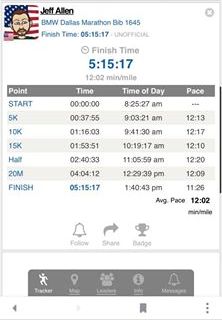
I set goal times:  5:20:15 – a 12:15 pace.   Where would disappointment begin? 5:30:00.   What was the best hope: 5:15:00 – this was a 12:00 pace.

to 5k:  DON’T Run.   Pace was too fast and I had to physically slow myself down.  I found a slower runner and stuck behind them for a 1/4 mile just to get me recentered.    5k split: 12:13.

to 10k:  I remember distinctly this part of the course last year.  Misery.  This part of the course heads uphill and it’s easy to get discouraged.  Today, I lost those miles.  I didn’t feel them.  I just counted mile makers.   Water/gatorade at mile 3 and six.  10k split: 12:17.

to 15k: All uphill: I worried over this part of the course pre-race, but I had done my study of the courses.  Water/gatorade and nutrition in this stretch (1x).  15k split: 12:10.

to Half: This is a downhill to level stretch.   No fear here.  Cruising.  Nine miles behind me – easy.  Now I can stretch it out a bit and head to the finish line.  Honestly, the thought crossed my head. Briefly. I was running easy, no hotspots, no “real” aches, and nutrition on point.   Keep to the plan, keep to the plan, keep to the plan.  Water and  gatorade every other mile.  Mile 13/Half split: 12:20.

to 20 miles: Long time on the feet, but everything was falling into place.  17 to 22 is the toughest part of this marathon.   I felt great as we moved from the flat (into the 15 mph southern wind) and onto the climb back into Dallas.   I expected a slowdown, but, my pace continued to quicken – perceived effort was up a little, but I was planning a negative split.  My first half of the race discipline was now paying dividends.  Feeling good – let’s stretch the legs. 20mile split: 12:09.

to the finish: I’m ahead of my goal time by at least a couple of minutes moving off of the climb, nutrition had a few problems (incorrectly relied on an aid station) but I was in the driver’s seat.  Mile 22 – 23 was contemplation – what now?  Settle, or attack?  Attacking meant and possibly heroic crash before the finish line.   Yep, attack it is.  I treated the mile 23 marker as a new 5k start line.   A tired start, but a start.   Outcome? My last 10k (6.1 miles) was finished at a 11:26 pace….I gained time each mile from 20 to 26.2.
15492293_10154794497009719_2127624443935819201_n.jpgHow tired?  Bone tired.  The wind nearly pushed me down at the top of a hill and in sight of the finish line.  But, I left everything that I had on the course.  Mind, body and spirit.

Marathon in the future?  Sure.  Longer? Maybe.  But next “A race” is Ironman Arizona  (@IRONMANArizona) in November 2016….a marathon after swimming and biking.

FINISH TIME: 5:15:17

FIVE MINUTE BETTER THAN GOAL!  Preparation!  Thanks Coach!


Disco Olympic Triathlon September 2016

September 11, 2016
– Jeff Allen

Statistics

Swim – 1500 yards (actually ~1850)
Bike – 24.0 miles
Run – 6.2 miles

Temperature was cool and the water was warm. Nearly perfect temperature at the starting line. The Texas wind was sleeping in for the day and left the lake with small swells 800 yards out from the start line. A dream scenario for a virgin no-wetsuit open-water one-mile swimmer. I remain a toddler at triathlon – my third race – a longer distance. I continue to build as an athlete.

A Quick Diversion

 Repeated in my mind countless time during the training whether hard, early, or in overtime: “You can’t cheat the grind…it knows how hard you’ve worked, the effort you have put in, and the time you’ve dedicated…it will only give you what you’ve earned.”

I made a very deliberate decision to cancel my planned races after the Texas man Sprint (May 22nd) to train rather than race.   I have a long journey in mind and the pit stops for celebration of accomplishments had to be put on hold so that I could get very serious about my triathlon training over the summer.

Why? I’m an old fat man that takes time to taper and to recover. This means two weeks of off time for every race for me.   I figured this would cost me up to 6 weeks of serious training over the summer. So, the summer training schedule was set. This included a one-week June trip to Leadville, Colorado to train with KMF beast in the mountain that were stingy with oxygen. In Colorado the fitness level of the KMF athletes again demonstrated the rewards of steady, progressive hard work.

 Off to the race

National Anthem meant a little more today.   9/11 remembered.

The question before this race: Am I a triathlete?   Each person has a different question in their mind before each race, this was mine – no explanation. I know I have the training, I know I’ve done the work. Can I put it all together in an Olympic-distance race?

SWIM: My first open-water swim without a wet suit and double my furthest race distance. This was a beach start for the open water swim, but the chaos of the last races didn’t appear.   The start for me was calm and my heart rate stayed steady as I entered the water and found a line. Michael Kaiser reiterated sage advice to find a pace swimmer. I worked to get in the draft of another swimmer…it didn’t work.

I repeated my race swim goal to myself. Prior to the race I stated “My goal is to keep a pace between 1:50 – 1:55 . . . I want to feel good leaving the water without weak legs.  Need to concentrate on my pull”.   I then ignored other swimmers and worked on a clean line between the swim buoys. A calf cramp at about 1000 yard forced me to concentrate more on my pull stoke and rest my legs for the next section of the swim course – just calm my kick a little bit. The cramp was a small blessing and I came out of the water feeling good. Goal accomplished.   However, flat water and a 2:10 swim pace meant that I was slower than I should have been for the conditions – I left some in the tank when I left the water. But then again, I stayed on plan – I’ll take that as a segment win.

BIKE:   My first Olympic distance bike race. Race plan: “Goals is to stay between 17-18mph.  Heart rate no higher than 160.” I set my bike goal too low. I knew it – coach knew it. Ben and I are still getting to know each other as coach and athlete so he kindly let it stand without censure.Screen Shot 2016-09-12 at 3.20.29 PM.png

My summer training, especially on the bike, had produce results moving me from a 215 ftp to a 255 ftp. My pre-race goal on the bike was really stating that I’m afraid of the run. I wanted to have enough left after the bike to put in a decent 6.2 mile run. So, I pushed a 19.9 on the bike with a heart rate between 165-170. This was not hammering – it was a controlled strong pace.   At this pace I knew that I could still run after the bike.  I raced the bike where my goal should have been for the distance.

NUTRITION: Struggled with my nutrition plan, again, but it was better than the last race – progress. Drinking/eating in fear of the bonk. It’s a work in progress. It showed in my run – too much intake of liquid. Simply didn’t need it.

RUN: My first 10k race segment.   My legs felt fine after coming off the bike. Coach Ben said AFTER race that the Olympic distance race is a dangerous– you want to go too fast in the beginning and if you do you pay for it at the end. Truth.   I never have a good first two miles. I couldn’t find my pace and I wanted to run…bad decision – immediate heart rate spikes that I worked to manage.   Race plan: “Negative split on run.  Keep the first three miles under control (11:30 – 12:00) and push last three miles at 10:30-10:45.”  I didn’t keep the first three miles under control. I didn’t keep the last three miles under control.   I felt out of control the whole time. I simply couldn’t keep my heart rate down. Finally in mile 4 my mind settled and simply ran the conditions. This meant a stiff fast hike up a two hills to settle my heart rate during the race – this hurt my ego. BUT, at the end of the race I keep an 11:09 pace – pace was steady(ish) from mile 1 to 6.2. Beat my run segment pace goals, but not the way that I should have done it.

Lessons

  • Positive not negative: Triathlon, like boxing, does not favor the coward. My race goals were extremely reasonable, too reasonable.
  • Nutrition tells the race: Need to continue to dial race nutrition in before NOLA ½ IM. Pre-race nutrition was perfect.
  • Enjoy the race: I stuck my tongue out at the first buoy (literally). I was enjoying the swim and knew that I had it beat at the 750 mark. The 1500 yard swim showed closer to 1850 yards. The distance didn’t matter on race day and I could have done twice the distance – at the pace. ***More racing, less enjoying. Enjoy the race!***
  • Building my base: At the end of Texas man I wrote: “Summer is coming and I have the opportunity to again concentrate on my base fitness. Game on.” My base is now solid and I can begin to build distance.
  • Running, Running, Running: Smooth is fast. My time/pace will improve on it’s own. I have to learn to be a better runner and become a comfortable runner. I’ve thrown down a gauntlet with the Dallas Marathon!   But, you can’t cheat the grind. I haven’t earned any better with my running thus far. It will come after a hard Fall of running.
  • Coaching: At the end of summer, I invested in structured coaching. Good move. It’s enhanced my absorption of triathlon knowledge. “When the student is ready the teacher will appear.”

#‎dotheblogthing #‎winning ‪#‎dothething ‪#‎kmfendure ‪#‎kmfperformance #thegrind

Texas man Tri Sprint 2016

May 22, 2016
– Jeff Allen

Statistics:

Swim – 500 yards
Bike – 16.1 miles
Run – 3.1 miles

Temperature was perfect at the starting line and the water was cool (wetsuit legal). There was a wind blowing into the cove that left a swelling chop coming directly at the start line.

I remain an infant at triathlon – my second race.

My personal life is crazy and the week leading up to the race left little time to prepare. Then Friday happened. A blown tire led to a barefoot walk on warm asphalt (with molten holes of tar). I realized when I reached home that I created a quarter-sized blister in the middle of BOTH forefeet.

The time leading up to the race was then filled with moleskin and athletic tape. Followed by feet propped up to heal. Of course, this didn’t happen – a banquet, packet pickup, groceries, etc. kept on me on sore wrapped feet. There was nothing to make the best of the bad situation. I walked to markup on sore feet and doubted my capability to finish the race. The way that the week developed it’s also little surprise that my morning nutrition was not my normal pre-race meal. A DNF on my second race?

SWIM: The beach start was chaotic and the predicted chop was actually swells with chop on top. This isn’t what I imagined for my first open water race. I got a rhythm and started sighting on the top of every second swell. I swam hard with the pack and took Ben’s advise on stroke turnover and churned against the swells. My only thought – get to the first turn and all will be good. Except it wasn’t exactly – I was toasted. I flipped my belly to the sky after clearing the first buoy and took a ten count (with a strong kick) to calm myself. This made all the difference in the world to my swim.

I couldn’t believe how tired I was after 250 yards. Turning the second buoy was a gift and it was downwind from that point. I hit the beach after 500 yards tuckered out – and, yes, on sore feet. I didn’t know at the time that I hit a 1:41 pace on the swim (big win). The recent open water practice made all the difference in my mind.

On to the strippers!

T1: Meant sitting in front of my bike (an understandable sin). But two precut moleskins were applied to damp, sandy feet and high-quality socks were added on top. A little bit of time was lost and it seems to take more than the true 30 seconds of application. After the race they were still to be perfectly positioned around the blisters. A stroke of luck! How did this happen with the sand, water?

BIKE:   This is when my pre-race lack of nutrition planning hurt me. My speed was fine at 19.1, but my gut didn’t like my nutrition and fluid choices – live and learn. Much of this was left in the grass at mile 6 with one foot off the bike. It was worth the break. But, I was fearful of was putting anything else in my system. Since it was a sprint, I chalked it up as a lesson and went on about my race. Getting passed by a 14 yo badass girl was great – there’s work to do! I admire her fitness. Good stuff.2ndTriSwim.jpg

T2: An easy transition filled with trepidation – I could stop with no fear of ridicule. To run or not to run. TO RUN! HTFU and get on the race course.

RUN: I had to run. My new Altras demanded a race. I started off too fast, but quickly settled into a pace I could keep for the course. The beginning of the run felt awkwardly, slow, and off while I experimented to get some relief from my self-created blisters – this wasn’t going to get the job done. I dug deeper and determined that there was no way to run around the blisters. I sank into my normal run cadence and simply ran on the blisters. By the one-mile mark the blister pain was set to the back of my head and and I had a normal-ish race ahead of me. My pace wasn’t the point today: 31 seconds off of my last race. This run was a mental win. Thanks team mates and coaches!

Lessons:

  • Mental is important: This was a short sprint but there was a lot involved. The blisters put me into a different place on the run and made me work on a different aspect of my game.   Past experience in other venues transferred to the race and provided me an opportunity to manage my race
  • Nutrition: Need to dial this in more and remember that pre-race is just as important as the race itself. This isn’t the first time that this issue has raised it’s head.
  • Race the day: The race is the race. The day is the day. The wind and weather will do whatever wind and weather do. Everyone has a different race.
  • Building my base: Summer is coming and I have the opportunity to again concentrate on my base fitness. Game on.

#‎dotheblogthing #‎winning ‪#‎dothething ‪#‎kmfendure ‪#‎kmfperformance #thegrind

Mean Green Triathlon Sprint

March 20, 2016
– Jeff Allen

The morning of March 20th was exciting – the annual Mean Green Tri. Breakfast was great and the nerves were well under control. It was fast and I finished my race. Hit the podium in third place My virgin triathlon experience was complete and I was ready for the next. So, there’s the story – the beginning, the middle and the end.

The reason of why, for me, is the important part of this experience.

I observed my first triathlon over a year earlier in August of 2014. I didn’t run that triathlon, but ran the 5k option as a weekend training run. The opportunity to train for triathlon began slowly enough in 2015 with a few 5ks, a 100-mile bike race, and ended with the Dallas ½ Marathon in December 2015. The desire to run a triathlon was strong in Fall 2015, but I didn’t simply want to do it to say that I just did a triathlon – I wanted to be prepared to compete. I had a great mentor in Max Atkinson during 2015 and knew what was ahead of me. 

Joining a club team was step #1 in my preparation for Mean Green. I researched and found THE team that would fit. After talking with Coach Ben, I sat in training for a few weeks to make sure that there was a match. KMF’s “do work” attitude was perfect for my style of training and the welcome to the team was simple: don’t waste our time, do work, find your place – perfect. I found everything that I needed in a competitive family of racers.

Do the work in winter training. I showed up in the midst of winter training and dove right into training – What was the training the second night: Sufferlandria Nine Hammers. Holly SH*$! YES! This was the day that I realized that the team was serious about training and knew that I had a home. My problem – I’m old, fat and slow. I worked during winter training to physically keep up and attended the training sessions (including every Tuesday Night Track session).

Winter training, for this newcomer to the sport, also meant: reading; watching countless training videos; asking questions; trying equipment; improving my race legs, improving my lungs; attending Tri Shop training sessions; finding extra workouts (swim); and developing a beginner’s training plan. The big winter questions: How do I optimize best training load to recover? What’s the balance needed for achieving my goals? Recovery takes more time with age…

 The starting of the season was March13th were I watched the team dominate at the St. Patrick’s Sprint. Yes, I snuck into the transition and took endless picture of setups and took a lot of “remember this” notes. This generated an intense week of completing quick laps at the stadium to work the transition and testing my setup.

The day of the race actually was COLD. 34 degree, 10mph wind out of the Northwest. This sound like a great start doing a singlet for the first time. My nerves were GREAT. My heart rate was under control and no butterflies. This surprised me – but, I’ve competed against other boxers for the last six years. This time, I was competing against me. What was my goal?   Hit a PR in all stages.

Swim:              2:00/100yd pace      PR/baseline

Transition 1:   1:15.0                        PR/baseline

Bike                  19.3 mph pace         PR/baseline

Transition 2:   52.7                           PR/baseline

Run:                  10.08 mph pace     PR/baseline

Total:               1:20:10.7                   PR/baseline

The serpentine swim was nuts. My lungs and legs were well prepared, but I stumbled over weaker swimmers in front of me – got caught behind a crowed pack. I slowed down to my average pace (1:55) and relegated myself to a slightly slower pace. I certainly could have pushed harder, but didn’t know where the edge was at this first race. I cracked the top of my right foot on the pool edge coming out of the pool though it didn’t impact my race. The time was expected. I was TIRED coming out of the short 400 yard swim – the nerves caught up with me.

I made a very clean transition in the pen and seemed to try my best to wreck by multitasking in my bike mount. Lesson learned. The bike leg was good, not great. I have do say that I was amazed and to be on the course with a number of my teammates that were much stronger than me. I never expected to see them. This gave energy and pushed my bike pace. I pushed hard on the bike to make up for my next leg. The time was expected.

I came into transition fast and ran through the transition in a perfect effort for me. Now my nemesis – the run. I’ve trained and worked on changing my running style during winter practice. Tuesday nights are priceless. My pace during the race was steady but I found myself settling into “relegated” pace rather than pushing. My third mile was better. Bullet Bob was behind me and the only thing that I would do was TRY to hold him off. Not really, hold him off, he is a much better athlete – but it gave me a running goal. I survived the run – my time was slightly better than I expected (thanks Bob).

meangreenbiketransitionAfter the race I felt relieved and accomplished – even for a sprint that was another training day for most. I have now competed in one race. I’m a superman – a PR in every category. My race PRs could also be called baselines. My goal of the race was to set baselines and rise to my training.
Goals? Of Course! Olympic in September, Dallas Full Marathon in December, ½ Iron in Spring 2017 and 2017 IMAZ. Why? I can stand on the shoulder of giants in our club that have an amazing base of knowledge. These goals are set without full confidence in their ability and my work ethic. Can it truly be done? I don’t know yet. I’m simply a new triathlete with an amazing team.

#‎dotheblogthing #‎winning ‪#‎dothething ‪#‎kmfendure ‪#‎kmfperformance #thegrind

Transitioning from Gym Rat to Fighter (The Equipment)

The first step from gym rat (not a negative) to fighter is more than simply saying “I want to fight”.  In any boxing gym, a gym owner is more that willing to teach the skill of the sweet science to students and provide training for any and all participants.

A gym rat has equipment.  If you look inside their equipment bag, you will find a number of pieces of boxing equipment that marks them as a gym rat or boxer:

1) a manufacturer gym bag  – gotta show your colors
2) standard workout clothes.
3) a jump rope
4) boxing shoes
5) hand wraps (120″)
6) boxing gloves (for the heavy bag)

This list covers 90% of the activities covered in the gym workout.  There are, of course variations between parts of the country and the gym, but stripped down this will get you in any boxing gym to learn the sweet science.     This is the stopping point for some, but if they have some interest in boxing there are a few more pieces that they need to move to be a boxer:

7) mouthpiece (price is in ratio to protection):  Don’t skimp on quality.   Dental and oral surgery is expensive and worth protecting.  ShockDoctor makes a great array of mouth guards: https://www.shockdoctor.com/nano-3d-mouthguard

For the beginning boxer, most gyms have a collection of headgear that can be used for occasional sparring.   This is typically rugged use gear that get a lot of use on a weekly bases by the gym rats that want a little more to become boxers.  With this small amount of gear, anyone can learn the art of science of boxing and utilize the aerobic and anaerobic workout that is world famous for building a better body, better character and a person that has the ability to defend themselves.   Boxer don’t necessarily attend tournaments, fight in competitions or have e a fighting record.  Many boxer will go many years simply in the gym work on mitts, pounding heavy bags, attending classes and occasionally participating in gym sparring.

A fighter has different equipment that marks them as a fighter.   Every fighter knows the signs when someone get serious about the sport and want to learn the sweet science from inside the squared circle.

A fighter begins by investing in their own equipment.   I personally seldom loan my fighting equipment to others and then only to trusted fighters.   As a fighter, you trust your health and safety to the equipment that you wear in the ring and your longevity as a fighter depends on this equipment.

1)  Sparring Headgear – quality sparring headgear is between $100 – $150 and provide large protection to your head.   EVERY fighter has a different opinion of headgear, but here’s a few good examples:

http://www.ringside.com/ringside/ringside-deluxe-face-saver-boxing-headgear-8764.html

http://www.ringside.com/ringside/contender-fight-sports-palladium-no-contact-headgear-8743.html

http://www.shopeverlast.com/professional-sparring-head-gear.html

Each fighter has their preferences, and may absolutely hate the face saver style.  However, they have a great advantage of giving you more rounds in the ring while lessening the possibility of injury.   We can argue the advantages and disadvantages of full-face vs cheek protector vs open face for vision – protection ability favors full-face.

2)  Sparring Gloves (16oz/18oz/20oz) – quality in your dedicated sparring gloves (separate from bag gloves) is important for both your hands and for the welfare of your sparring partner.   Glove technology is changing at a rapid pace and there are many manufacturers that provide excellent gloves.   Ask yourself is your willing to have your partner use your old worn out gloves while sparring you.    Knots in laces, hanging string, worn covers and flattened protective filling are dangerous and distracting in a the learning environment of a sparring ring.

3)  Groin Protector – YES!

4) Shoes – Quality boxing shoes must be acquired.  Wear sliders or street shoes from the car to the gym and use boxing shoes exclusively within the gym.

5) Competition Uniform – Quality shorts, and jersey for amateurs,  that are professional and meet competition guidelines.   The night of a fight is no the time to be opening packages and popping tags.

6) Competition Headgear – Competition headgear is inherently lighter and not for everyday use.  I few sparring sessions to check fit – absolutely

And finally, use deodorant….

Hand up * Head down * Keep Moving!

Prof