Tag Archives: #IMAZ2017

Ironman Arizona 2017

Tempe, Arizona
November 19, 2017

I’ve looked forward to Ironman Arizona (IMAZ) 2017 for over a year.  I traveled to volunteer in 2016 to watch and support team mates AND see what I was getting myself into for 2018.  This entire year was about being prepared for this IMAZ 2017.   This isn’t to say that I didn’t concentrate and race other races, but I considered them formative races to this big day.

Race Conditions:  For the 10 days leading up to the race the forecast was 82 degree with 0 – 5mph winds.   This changed on race day.  My data shows a high of 86 degrees and winds between 10 – 20mph depending on time and place on course.  The water was a brisk, 68 degrees and the air temperature low dropped to the mid 50s once the sun set.  Hot and windy during the day and wonderful at night.

Goals: 1) Finish 2) Enjoy the day 3) Race to Plan. These are simple goals, but the third goals was dangerous for a first Ironman.  Two goals were plenty – don’t have a race goal, don’t have a race goal, but you’ll have a personal race goal

Before the Race:  I traveled to Arizona six days before the race to spend time getting into mindset, acclimating, and enjoying the pre-race activities. Great for a first-timer, less for a veteran.  The days before the race, we had a chance to jump in the lake to check sight lines and water temperature (best thing I did for my race start).

Morning of the Race:I took this morning slow and steady and my goals was no stress.  Of course, I forgot my timing chip and had to get a new one.  All was good and prepared to start the race.  My sherpa did a great job of communicating with me and allowed me to worry about the race and not the gear.

SWIM

There was nothing special about the swim but a cool 68 degree water that was warmer than expected, but cool enough not to overhead during a 2.4 mile swim.  Due to previous day scouting, I had my first long sight line and took off with very little hesitation.  I got into a great rhythm and headed counter clockwise down the first line.  The course was shaped like a bent elbow.

I had a steady swim pace where I could have pushed the pace at many points.  Due to the distance, I settled into a felt steady/moderate pace.   I was around the far
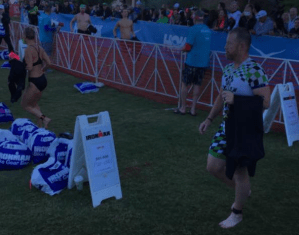
turn buoys and down the back stretch, but a calf ready to cramp was distracting me and the sight line was LONG.  At about 3000 yards, I lost my swim stroke and kick. It took a couple of minutes to find the groove – it was lost.  I was a log sitting in the water paddling without noticeable forward progress. I had to go back to swim basics and do each step of the process to eventually find it and take off. My swim volume this year was my savior:

2017 Swim Volume: 106.71 mi (187,810 yards), 73:19:34 h:m:s

IMAZ Swim Time: 01:21:13

I felt appropriately tired, but satisfied coming out of the water with an aggressive swim plan time of 1:20:00.  I didn’t overrace this leg (cost me a hamburger bet), but I raced the swim as I need to for an “A” race.

BIKE

My mantra: Do not override the bike, do not override the bike, do not override the bike.  I love to override the bike portion of the race.  I set my goal at a 19mph pace.  The data tells the story. 
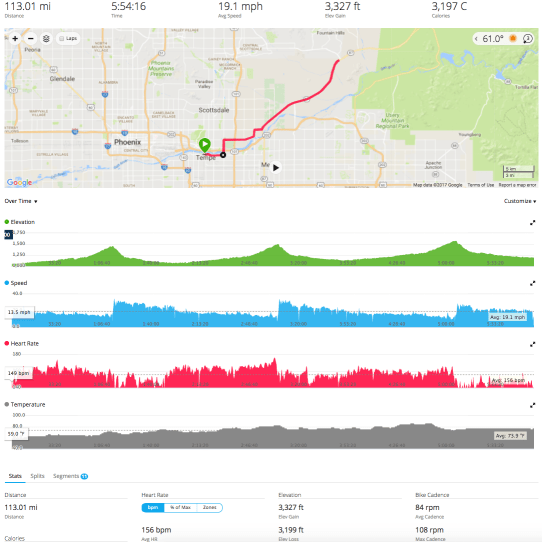
2017 Cycling Volume : 3,187.23 mi, 216:19:43 h:m:s
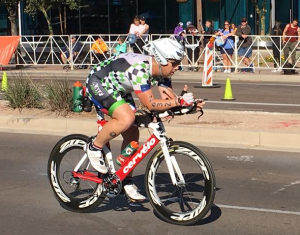
IMAZ Bike Time: 06:00:06

Yes, I could have had a faster bike time.  Ironman data said I rode 18.68 and my bike computer showed a 19.1 average.  This was my biggest win of the day.  I was not tired coming off of the bike – cramped up and sore, but my legs felt great.  Exactly were I wanted to be off the bike.

RUN

I worried about the IMAZ run ALL year.  For good reason.   I felt great coming off the bike at 2:45p.  But it was HOT.  I started fast and closed it down quickly with the heat.  I was well within my ability to finish the race and had plenty of time to finish within my race goal.   Other than the heat, I felt really good.  I did pull something under my right rib (during swim) that gave me some pain, but that’s the name of the game.  I took the first hour slow to let the sun drop out of the sky a little and took the opportunity to refuel, rehydrate and get ready for the long haul to the finish line.   Between mile 4 and 13 I had a steady pace that I thought I could handle forever.

At mile 13, my back started to ache.  This wasn’t a surprise – it’s the first of my running structure that breaks down.  But this was early.  I mentioned it to Kara (Max’s Sherpa), but kept going – just something for her the mull over.  This was a critical decision time: a) slow my pace and save the back, or b) race to plan.

By mile 16, my back was hurting and I was now on the walk.   The pain was manageable, but the ibuprofen that I took weren’t making a dent.  I knew at that the remainder of the race was going to hurt – Nick (team mate) was a good sounding board on course – I kept going – a forward lean was noticeable.  By mile 20, the grandpa lean/hunch had become a serious problem.

At mile 22/23, I was in trouble.   I completely stopped for the first time on the course.   I was in serious pain and I needed to find relief.  I found a railing and stretched my back on it – reaching down as close to the ground as possible and cat arching my back.   This gave some temporary relief.  I had base-salt all day. I had three “hot shot” and at this point I had enough ibuprofen for a couple of days.   I was warned that there are dark place on the run course – there are and I was facing it.

The last five miles of this race felt like the whole race.  My stretches started to get closer together.

The mile 24 aid station was a ugly, hard place – under a lit bridge at the bottom of a downhill and coming to an uphill.  I stretch long and hard but kept moving forward.

I saw my support team for the last time (last of many) and Coach Ben knew my status by the look on my face and my form.  We’ve worked enough together that the pep talk was of goals and possibility.  Nothing to do with the pain, or my willpower to finish.

There was only me, the UNT tri-club supports, and my coach at the time. The rest of the world simply didn’t exist at that moment. I apologies, again, to the children and families on the sideline for my load four-letter word (twice).

1) Finish 2) Enjoy the day 3) Race to Plan. 

To make my race goal #3, I had to pick up my pace.  I tried for the next 200-500 yards.  It simply could not happen.   Goal #1 (finish) was still 2+ miles away.  Goal #2 (Enjoy the day) was a long time ago.

Mile 24 – 26.2 were, mentally, the toughest of my life.   I’m quick to note: There are many people who suffer this way everyday with their lives.   I could have stopped at any point and the pain would have gone away.  I chose this fight – I was fighting mental against physical.   Physically, everything in my body, except my back erector muscles were great.

At mile 25.5, I headed toward two EMTs on a four-wheeler.  As the rushed to my aid, I yelled at them not to touch me and used their vehicle to stretch my back.  This was strategically my worst mistake – I had two care takers that were more than willing to ease my pain – It was hard to tell them not to touch me.  “What do you need?”  The finish line.  “What can we do for you?” Nothing.  I knew that the point that I allowed them to take over my care that I lost my ability to decide if I would be allowed to finish the race.  I left them with painful whispered thanks and headed to the finish line.

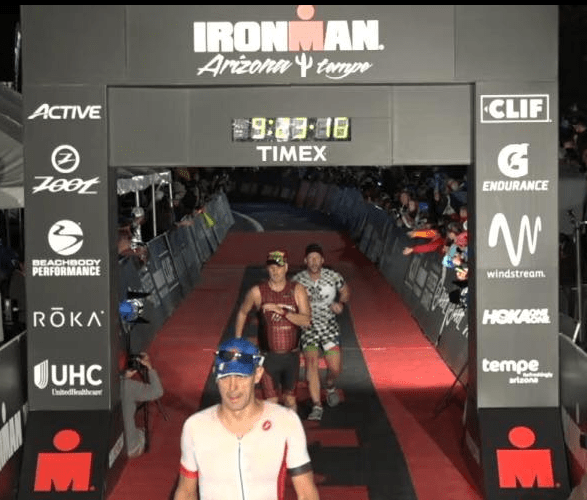
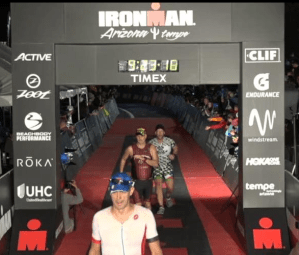
Mile 26.1: Denise (my wife) asked me to run down the carpet. This wasn’t something I even contemplated for the last five miles. But, you have a lot of time to reflect during the race and I had decided to make it happen to the best of my ability. Luckily, Nick had positioned himself at the start of the carpet and I was able to stretch and had him extra stuff.  No time to full explain what I was doing – he just didn’t want me to stop!  I stretch and took off standing 100% tall breathing hard to hold myself up – not from being tired, but controlling the pain with breathing.  Looking at the video I was anything but tall. But, I finished at 14:16:04 (9:23p).

2017 Run Volume: 840.83 mi, 183:18:24 h:m:s

IMAZ Run Time: 6:36:00 


OVERALL TIME: 14:16:05

OTHER NOTE

Mentally: I was 100% ready everything that race could have thrown at me.  I was ready for the worst.  I’m glad I was ready.  At any point, I could have rested at done a 17 hour race without so much pain.  Mentally, I pushed my physical.

Done Right: Stay with my race plan.  I trusted the plan and knew that my coach agreed.

Improvement:  This is easy. Become a better endurance athlete.  Work on that erector core.

Differently: Nothing.  Done right.

Lessons: The mental is as much or more that the physical and they will bleed into each other.  More study needed.

Back to Training: Coach know what I need.

Next race:  Rocky Raccoon 50 mile race.  My run is my weakness.  Kill the weakness.


Back to the grind.

Thanks Everyone!!!!
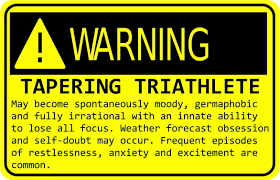
 

The Ironman Taper

I’m NOT the original author – going to keep it here so it can be linked in the future….

Per Ellen Frasca Evans the original author is Bob Mina. Written before before Ironman Canada in 2002

There are a lot of different sources and a couple of versions – this one hit’s it just about right and was posted by my teammate Ironman Paul Beaty before 

his first Ironman at IMAZ 2016.  I hope to cross the finish line of Arizona in 2017.
It’s been a long year of “the grind”.   The coaches and the team have me prepared.  Family is ready for this first Ironman to be done.   IM Arizona in seven days.


Enjoy!


The Ironman Taper


Right now you are about to enter the taper. Perhaps you’ve been at this a few months, perhaps you’ve been at this a few years. For some of you this is your first IM, for others, a long-overdue welcome back to a race that few can match.

You’ve been following your schedule to the letter. You’ve been piling on the mileage, piling up the laundry, and getting a set of tan lines that will take until next year to erase. Long rides were followed by long runs, which both were preceded by long swims, all of which were followed by recovery naps that were longer than you slept for any given night during college.

You ran in the snow.
You rode in the rain.
You ran in the heat.
You ran in the cold.
You went out when others stayed home.
You rode the trainer when others pulled the covers over their heads.

You have survived the Darwinian progression that is an Ironman summer, and now the hardest days are behind you. Like a climber in the Tour de France coming over the summit of the penultimate climb on an alpine stage, you’ve already covered so much ground…there’s just one more climb to go. You shift up, you take a drink, you zip up the jersey; the descent lies before you…and it will be a fast one.

Time that used to be filled with never-ending work will now be filling with silent muscles, taking their final, well-earned rest. While this taper is something your body desperately needs, your mind cast off to the background for so very long, will start to speak to you.

It won’t be pretty.

It will bring up thoughts of doubt, pain, hunger, thirst, failure, and loss. It will give you reasons why you aren’t ready. It will try and make one last stand to stop you, because your brain doesn’t know what the body already does. Your body knows the truth:

You are ready.

Your brain won’t believe it. It will use the taper to convince you that this is foolish – that there is too much that can go wrong.

You are ready.

Finishing an Ironman is never an accident. It’s the result of dedication, focus, hard work, and belief that all the long runs in January, long rides in April, and long swims every damn weekend will be worth it. It comes from getting on the bike, day in, day out. It comes from long, solo runs. From that first long run where you wondered, “How will I ever be ready?” to the last long run where you smiled to yourself with one mile to go…knowing that you’d found the answer.

It is worth it. Now that you’re at the taper, you know it will be worth it. The workload becomes less. The body winds up and prepares, and you just need to quiet your worried mind. Not easy, but you can do it.

You are ready.

You will walk into the water with 2000 other wide-open sets of eyes. You will look upon the sea of humanity, and know that you belong. You’ll feel the chill of the water crawl into your wetsuit, and shiver like everyone else, but smile because the day you have waited for so VERY long is finally here.

You will tear up in your goggles. Everyone does.

The helicopters will roar overhead.
The splashing will surround you.

You’ll stop thinking about Ironman, because you’re now racing one.

The swim will be long – it’s long for everyone, but you’ll make it. You’ll watch as the shoreline grows and grows, and soon you’ll hear the end. You’ll come up the beach and head for the wetsuit strippers. Three people will get that sucker off before you know what happening, then you’ll head for the bike.

The voices, the cowbells, and the curb-to-curb chalk giving you a hero’s sendoff can’t wipe the smile off your face.

You’ll settle down to your race. The crowds will spread out on the road. You’ll soon be on your bike, eating your food on your schedule, controlling your Ironman.

You’ll start to feel that morning sun turn to afternoon sun. It’s warmer now. Maybe it’s hot. Maybe you’re not feeling so good now. You’ll keep riding. You’ll keep drinking. You’ll keep moving. After all, this is just a long training day with valet parking and catering, right?

You’ll put on your game face, fighting the urge to feel down as you ride for what seems like hours. You reach special needs, fuel up, and head out.

By now it’ll be hot. You’ll be tired. Doubts will fight for your focus. Everyone struggles here. You’ve been on that bike for a few hours, and stopping would be nice, but you won’t – not here. Not today.

You’ll grind the false flats to the climb. You’ll know you’re almost there. You’ll fight for every inch of road. The crowd will come back to you here. Let their energy push you. Let them see your eyes. Smile when they cheer for you – your body will get just that little bit lighter.

Grind.
Fight.
Suffer.
Persevere.

You’ll plunge down the road, swooping from corner to corner, chaining together the turns, tucking on the straights, letting your legs recover for the run to come – soon! You’ll roll back – you’ll see people running out. You’ll think to yourself, “Wasn’t I just here?” The noise will grow. The chalk dust will hang in the air – you’re back, with only 26.2 miles to go. You’ll relax a little bit, knowing that even if you get a flat tire or something breaks here, you can run the damn bike into T2.

You’ll roll into transition. 100 volunteers will fight for your bike. You’ll give it up and not look back. You’ll have your bag handed to you, and into the tent you’ll go. You’ll change. You’ll load up your pockets, and open the door to the last long run of your Ironman summer – the one that counts.

You’ll take that first step of a thousand…and you’ll smile. You’ll know that the bike won’t let you down now – the race is down to your own two feet. The same crowd that cheered for you in the shadows of the morning will cheer for you in the brilliant sunshine of a summer Sunday. High-five people on the way out. Smile. Enjoy it. This is what you’ve worked for all year long.

That first mile will feel great. So will the second. By mile 3, you probably won’t feel so good.

That’s okay. You knew it couldn’t all be that easy. You’ll settle down just like you did on the bike, and get down to your pace. You’ll see the leaders coming back the other way. Some will look great – some won’t. You might feel great, you might not. No matter how you feel, don’t panic – this is the part of the day where whatever you’re feeling, you can be sure it won’t last.

You’ll keep moving. You’ll keep drinking. You’ll keep eating. Maybe you’ll be right on plan – maybe you won’t. If you’re ahead of schedule, don’t worry – believe. If you’re behind, don’t panic – roll with it. Everyone comes up with a brilliant race plan for Ironman, and then everyone has to deal with the reality that planning for something like Ironman is like trying to land a man on the moon; by remote control; Blindfolded.

How you react to the changes in your plan will dictate your day. Don’t waste energy worrying about things – just do what you have to when you have to, and keep moving. Keep eating. Keep drinking. Just don’t sit down – don’t EVER sit down.

You’ll make it to the halfway point. You’ll load up on special needs. Some of what you packed will look good, some won’t. Eat what looks good, toss the rest. Keep moving. Start looking for people you know. Cheer for people you don’t. You’re headed in – they’re not. They want to be where you are, just like you wanted to be when you saw all those fast people headed into town. Share some energy – you’ll get it right back.

Run if you can.
Walk if you have to.
Just keep moving.

The miles will drag on. The brilliant sunshine will yawn. You’ll be coming up to those aid stations fully alive with people, music, and chicken soup. TAKE THE SOUP. Keep moving.

You’ll soon only have a few miles to go. You’ll start to believe that you’re going to make it. You’ll start to imagine how good it’s going to feel when you get there. Let those feelings drive you on. When your legs just don’t want to move anymore, think about what it’s going to be like when someone catches you…and puts a medal over your head… all you have to do is get there.

You’ll start to hear the people in town. People you can’t see in the twilight will cheer for you. They’ll call out your name. Smile and thank them. They were there when you left on the bike, and when you came back, and when you left on the run, and now when you’ve come back.

You’ll enter town. You’ll start to realize that the day is almost over. You’ll be exhausted, wiped out, barely able to run a 10-minute mile (if you’re lucky), but you’ll ask yourself, “Where did the whole day go?” You’ll be standing on the edge of two feelings – the desire to finally stop, and the desire to take these last moments and make them last as long as possible.

You’ll hit mile 25. Your Ironman will have 1.2 miles – just 2KM left in it.

You’ll run. You’ll find your legs. You’ll fly. You won’t know how, but you will run. The lights will grow brighter, brighter, and brighter. Soon you’ll be able to hear the music again. This time, it’ll be for keeps.

Soon they’ll see you. Soon, everyone will see you. You’ll run towards the lights, between the fences, and into the night sun made just for you.

They’ll say your name.
You’ll keep running.
Nothing will hurt.

The moment will be yours – for one moment, the entire world will be looking at you and only you.

You’ll break the tape at the finish line, 140.6 miles after starting your journey. The flash will go off.

You’ll stop. You’ll finally stop. Your legs will wobble their last, and suddenly…be capable of nothing more.

Someone will catch you.
You’ll lean into them.

It will suddenly hit you.
YOU ARE AN IRONMAN!

You are ready.
You are ready.

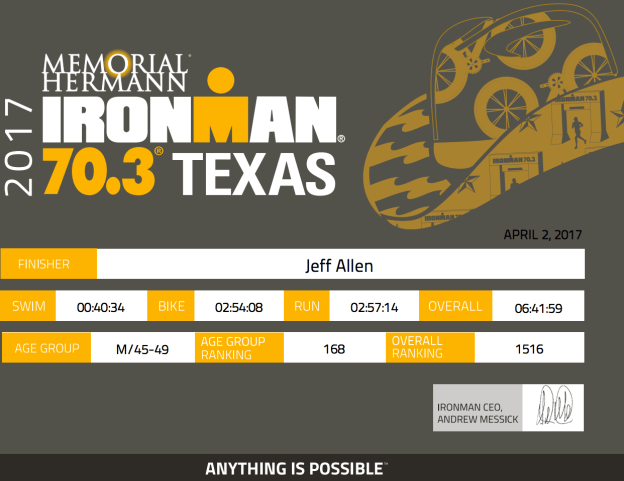
Ironman 70.3 Texas

April 2, 2017

First ½ Ironman!

Weather overcast and 70 – 80 degree for race time with 90% humidity.  Water 74.5

This was a much-anticipated race and the first of three 70.3 races in preparation for Ironman Arizona 2017.   This was a race – not a training session. I’ll find myself often saying that I’m using one race to prepare for the next, but nothing can be further from
the truth.   During each race, I purposefully experiment with a couple of different ideas to learn how they work.  Since I’m not yet a podium racer, I have the luxury of testing during my races.   I love competition and have a goal of getting my time faster than the mean of my age group – not quite there yet.

I’m going to treat this as a race report and provide a little more insight than I’ve normally taken in my report/blog.

Skip next two (nutrition and hydration) sections if not interested:

Nutrition

Nutrition was an important part of preparation for this race and a weakness in previous race preparations.  Here are the numbers prepared and used:

Pre-race        100 calories – Tailwind liquid nutrition in throw-away bottle
150 calories – Cliff squeeze | replace with real banana next time.
150 calories – Honey waffle

Pre-race nutrition was planned at 300 calories – due to lack of two bananas, it was supplemented with other nutrition with no ill results.  I prefer the real food of bananas with the potassium, carbs and sugar.   Light breakfast and 250 calories consumed during 1.5 hour prerace – couldn’t stomach squeeze nutrition.   250 calories are perfect for prerace and after light breakfast upon wakeup.

Bike               600 calories Tailwind liquid nutrition in two bottle on back of bike
Water in torpedo on front of bike
200 calories in squeeze Gu
300 calories – Honey waffles
One tube of Base salt

My goal of bike nutrition was planned at 250 – 300 calories per hour on the bike on the bike   – took in 1100 calories for 2:54:08 the only remaining nutrition was approximately 100 calories of Tailwind that was inaccessible after mile 45.   It was tough consuming calories and tough juggling bottle in a hard crosswind.   But done.

Run                200 calories in squeeze Gu
200 calories Cliff Shot chews
One tube of Base salt
4 sticks of gum
4 pieces of ginger candy

Run nutrition was unable to be tested.   But, based on what I consumed of course fuel, I should have packed 400 calories of squeeze Gu rather than 200. 400 emergency calories should be just about right.   Candy/gum is good, but ½ what was packed.  Chews are unnecessary with course nutrition.  I’m traveling slow enough to consume course nutrition if not Gu.   Course squeeze nutrition cannot be counted on since you don’t know the flavor.   I picked up course squeeze nutrition on bike and run and only tasted it before disposing.   Nothing wrong, but not the mouth tasted I WANTED.  Next time:

400 calories in squeeze Gu – coffee and peanut butter
one tube of Base salt
4 sticks of gum
4 pieces of ginger candy

Hydration

This was an area of experimentation on this race.   I wish I did better here and thought it through completely before the race.   I trusted that my liquid nutrition would hold me on the bike and course hydration would hold me on the run.   I was wrong.

Next time: I will have a hydration bottle with me on the run.  This is something that I need to start using on every long run to get use to the idea. I sweat a lot and I need to have a better idea of my liquid intake.  I skipped some watering holes because I simply didn’t want to deal with the little bit of water/Gatorade.   I observed bottle filling on the course and it’s a good way to load up on one and skip a couple and easily water/Gatorade mix.   My hydration test after the race showed not enough water consumed on course.  PLENTY on the bike and prerace, but not on the run.
Base Salt:  I believe that this saved my race.  It was a planned experiment for the race.  This is the first time using salt during any of my training or racing.  Yes, I took the chance of something brand new on race day.   But, it was planned three weeks before the race. Not a high-risk chance.   I consumed salt on the bike approximately every 5 mile until mile 34 when the tube was lost (more in bike report).  There were a LOT of people hurting during this humid race – I wasn’t one and contribute it more to the salt than consistent water intake.   This will now be a critical part of my plan since I will be on the run course during the hotter parts of the day.

The Race

Overall, it was a bitter-sweet race.   In a wreck at mile 34 that I cost me a very good bike time it turned from sweet to bitter.  Before mile 34 my race plans were on track.  After mile 34 the race was about finishing strong despite the race problem.  The details:

Swim

I did not know how to estimate my swim time for my first open ocean swim, I simply calculated what I could do in the pool – 1:47.   Wrong.    This was a rough choppy swim with big choppy/inconsistent swells on the backside.   Summary, the swim was great.

I used my coached pointer of getting my space (Thanks Coach Liz!) and mixed it up in the mass start. It was a fun start and I made it out of the first 300 yard largely unscathed by defending space. Big and strong helps here.

Screen Shot 2017-04-03 at 6.53.08 PMThe first and second turns required a left side breathe and the next two required a right – lucky, I got fussed at about this about 4ish weeks before and had worked at every practice with opposite breathing each length of the pool.   This correction and my athlete follow-up of consistent practice saved my bacon on the swim. Salt water on the swim is nasty.
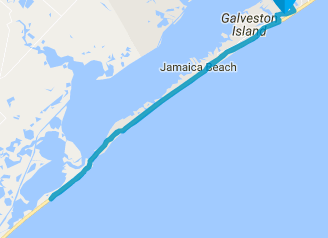
A lot of work is needed on swim drafting.   I tried to draft with only mild success and finally stuck to the clean water – review of my swim map showed consistency in sighting.

Last turn, I messed up by experimenting: I had not previously tried a 90 degree tight turn around a buoy in practice but, I decide that this was the right time (idiot).  Calf cramp from my inexperience and a wave that hit at the wrong time.  Lesson learned!  I executed an advanced swim technique that I had seen and tried once that could have cost me as the day went further.

For the first time in race conditions, I trotted out of the water in good shape – best I’ve felt after swimming any distance.   1:55 / 100 splits.  Inconsistent paces during the race need to be cleaned up, but overall very satisfied.

Time: 00:40:34, Estimated: badly.

Transition 1:

Garmin showed a 2-minute transition and Ironman recorded 04:37. Ironman results seem right after I changed into socks for the bike.   This was a smooth transition for the day with shoes packed in plastic in case of rain.   My transition area was laid out well and I felt good.  Nothing that I would change for transition, apart from a place planned for my used swim equipment.

Bike

This was the toughest bike conditions that I have had during a race.   Inconsistent crosswind between 18 – 25 meant working to handle the bike all day.   Minimal elevation change meant that power had to be controlled and maintained on this out-and-back course.   Humid ocean winds meant that bottle were wet and slippery think juggling and navigating a bike.

Screen Shot 2017-04-03 at 7.11.42 PMMy bike nutrition, hydration and salt were consumed on time and were digestible.   The first 34 miles were textbook for me with an extra Gatorade endure pulled from an aid station for easy slug right after the turn around.
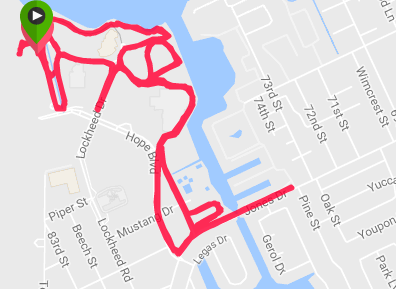
The bike accident at mile 34 was at the top of a windy bridge with an ugly front crosswind.   An ?inexperienced? cyclist couldn’t handle themselves and decide that I was their safe space and crashed me.   I was devastated when it happened.   I saw my race vanish in puff of smoke.   Four minutes and fifteen seconds had me back on my bike and heading home. I apologize to any on the bridge to the mainland for my language during this time – it would have made sailors blush.  A second quick stop for a check of wheel and alignment double-check cost me another two minutes and fifteen seconds.   I was then stuck to one gear for the next ~14 miles (within walking distance of transition) before I began experimenting with gears.  This meant little ring and little gear – not bad, just not what I need to make optimal power/time.   I then tentatively changed gears and created a better attitude (less cussing) for the remainder of the bike.

I pulled into transition, for the first time, with a sigh of relief that I had survived the bike portion and made it to the run.

Time: 2:54:08, Estimated: 2:57:02.   Great time for a tough race day course and an accident mixed in.

Transition 2:

Transition time was 05:26. I wanted to hurry with purpose, yet gather myself for the 13.1 miles left in the race.   But, I was looking forward to the run.  I worked my winter training season to improve my run fitness. I did change my socks, possibly unnecessary – simply wanted dry socks. Nothing that I would change for transition.  I bottle with nutrition would have been a bonus.

Run

Trotted from my bike to the run before turning the corner and starting a jog.   Didn’t feel great, but I had a full-bladder. Well-hydrated.  Didn’t want to stop, but it was welcomed.   I started my jog with tired legs for the first mile and felt my head begin to pound.    I had busted my noggin on the concrete during the crash and my slight headache increased dramatically.   I slowed and walked and started again with a run/walk to see if I could shake what I was feeling.   Yes, legs were tired, but the impact difference between a walk and jog was dramatic.   Again, race hopes faded.

Screen Shot 2017-04-03 at 7.13.45 PMI walked for the next two miles to settle and experimented again in mile 4.  I knew that my race was done and my goal was completion – with a long walk “this is my race”.   This is the way it continued to the end.
Medically, all is good.  I simply relegated myself to the fact that that a walk was manageable today.   In mile 5, my mind was settle and I set my pace at a stiff power walk and mild cussing.  It was good to be on the course with other competitor that were in much worse shape and fighting their own demons.

Time: 2:57:14, Estimated: 2:57:02.

I’m going to use Coach Amanda’s prompts for the next portion:

Mentally

DNF on my first attempt at a 70.3 was stuff of nightmares (literally from two-nights before).  This was a mental race after the bike crash – after assuring I two wheels to ride back to transition.  Age has its advantages.  I knew that even with a possibly chipped elbow or re-broken clavicle that I WOULD ride if the bike would take me – road rash was just an irritation.  I had 43 different references that were worse situations than my current position.  If I would get me and my bike back to the transition, I knew that I could conquer the run.   Little did I know that the race had another surprise – no run for me.

Not running again conjured images of a DNF on my first attempt at a 70.3.  My inexperience in triathlon gave me plenty of room for stoppage reasons.   By the end of the 1st of three laps, but attitude was much better by managing my expectations.  A one hour lap meant that my race goals were blown.

Done Right

Researched, recorded, and successfully implemented nutrition plan.  Stay with my phase of the race without much planning beyond the next 10 minutes in front of me – this kept.   Swim had many places for hiccups, found my happy place and stayed there – pacing was good.

Improvement

Fitness and daily nutrition.   Not 100% sure that I could have run the entire 13.1 miles; not required, but desired.   Need to be at race weight by next race in 89 days – said before – I’m getting there.

Differently

Need to be aware of the others that were doing  things on the course.  At my normal start time, there are numerous unprepared athletes that can impact your race.   Additionally, salt and hydration needs to be a mainstay of my long course plans.

I regret not celebrating this race more at the finish.  I was pissed as I came into the finish line.   I’m not sure that it was reflected in any of the pictures, but it was there.  I have a great family, teammates and coaches that committed a lot of time to getting me across that finish line.  My pride was hurt that I couldn’t put it all on the line.   I saw, twice, my race finish vanishing from me.  Over 84 in my age group did not finish (I counted that would have been pleased to be in my place walking across the finish line.  Suck it up buttercup. Need to enjoy the good and bad – embrace the suck.

Lessons

Trained harder and longer with more bricks – the long distance is fitness, fitness, fitness.  Use upper body for swim and use it as a good “warm-up” for the remainder of the day.  Overcome what you can and accept what you can’t is easier said than done.

Back to Training

More bricks – the long distance is fitness, fitness, fitness.  Need to learn to use my arms as oars and pull myself through the water – I’m thinking about swimming in the wrong way – need to continue to change and make this part of the race easier – not faster, just easier.   Need to stay in the moment during training and concentrate on what I’m training rather than filling the time with other “non-training” activities.

Next race

Buffalo Spring will be in 89 days.    This means that I have a significant training block to increase my long-course fitness.  I would like to see a swim less that 00:40 with less effort and a completed run.    This is a much harder race from my understanding – a DNF is waiting if my preparation is lacking.


Dallas Marathon December 2016

I ran the Dallas half marathon in 2015 with a 2:29:20 negative split with a 2:30:00 goal.  I had to suffer to make it happen.  As I signed up for the marathon distance I was prepared to suffer twice as long.   As I heard many times, from many different athletes, “the Marathon ain’t no joke.”

Fall 2016

I had the distinct pleasure of racing with@kmfperformance in 2016.  This group took my previous athletic training to another level.   The spring and summer were filled grueling training, a Colorado training camp, and great teammates guided by accomplished and competent coaches.   After establishing a base of training as a self-coached athlete, I approached Coach Ben Drezek to become a coached-athlete.  Why so long?  To be honest I didn’t want waste my money or coaches time until I reached a fitness level where actual training could begin without wasting valuable time-resources.

Best decision I’ve made in my athletic career.  Outcome? Fall training was injury free – the first rule of getting to the starting line.

Fast forward to December 11, 2016

Heading to the official start line, I was prepared (Heart, mind, body and spirit).   This is the way that I wanted to come in this race.    The morning was foggy and approximately 50 degree.   4:30 breakfast of peanut butter, tortilla and a banana.  With added nutrition at 8:00a for the 8:30a start.

As I moved from my car for an 8:10 corral closure I knew it was going to be a successful day.  Suffering, yes.   On the top of my right shoe is written “ETS” – Embrace the  Suck. No doubt of finishing.

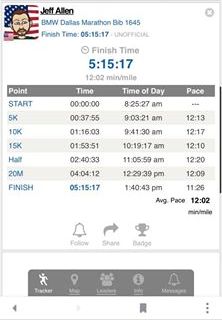
I set goal times:  5:20:15 – a 12:15 pace.   Where would disappointment begin? 5:30:00.   What was the best hope: 5:15:00 – this was a 12:00 pace.

to 5k:  DON’T Run.   Pace was too fast and I had to physically slow myself down.  I found a slower runner and stuck behind them for a 1/4 mile just to get me recentered.    5k split: 12:13.

to 10k:  I remember distinctly this part of the course last year.  Misery.  This part of the course heads uphill and it’s easy to get discouraged.  Today, I lost those miles.  I didn’t feel them.  I just counted mile makers.   Water/gatorade at mile 3 and six.  10k split: 12:17.

to 15k: All uphill: I worried over this part of the course pre-race, but I had done my study of the courses.  Water/gatorade and nutrition in this stretch (1x).  15k split: 12:10.

to Half: This is a downhill to level stretch.   No fear here.  Cruising.  Nine miles behind me – easy.  Now I can stretch it out a bit and head to the finish line.  Honestly, the thought crossed my head. Briefly. I was running easy, no hotspots, no “real” aches, and nutrition on point.   Keep to the plan, keep to the plan, keep to the plan.  Water and  gatorade every other mile.  Mile 13/Half split: 12:20.

to 20 miles: Long time on the feet, but everything was falling into place.  17 to 22 is the toughest part of this marathon.   I felt great as we moved from the flat (into the 15 mph southern wind) and onto the climb back into Dallas.   I expected a slowdown, but, my pace continued to quicken – perceived effort was up a little, but I was planning a negative split.  My first half of the race discipline was now paying dividends.  Feeling good – let’s stretch the legs. 20mile split: 12:09.

to the finish: I’m ahead of my goal time by at least a couple of minutes moving off of the climb, nutrition had a few problems (incorrectly relied on an aid station) but I was in the driver’s seat.  Mile 22 – 23 was contemplation – what now?  Settle, or attack?  Attacking meant and possibly heroic crash before the finish line.   Yep, attack it is.  I treated the mile 23 marker as a new 5k start line.   A tired start, but a start.   Outcome? My last 10k (6.1 miles) was finished at a 11:26 pace….I gained time each mile from 20 to 26.2.
15492293_10154794497009719_2127624443935819201_n.jpgHow tired?  Bone tired.  The wind nearly pushed me down at the top of a hill and in sight of the finish line.  But, I left everything that I had on the course.  Mind, body and spirit.

Marathon in the future?  Sure.  Longer? Maybe.  But next “A race” is Ironman Arizona  (@IRONMANArizona) in November 2016….a marathon after swimming and biking.

FINISH TIME: 5:15:17

FIVE MINUTE BETTER THAN GOAL!  Preparation!  Thanks Coach!


Disco Olympic Triathlon September 2016

September 11, 2016
– Jeff Allen

Statistics

Swim – 1500 yards (actually ~1850)
Bike – 24.0 miles
Run – 6.2 miles

Temperature was cool and the water was warm. Nearly perfect temperature at the starting line. The Texas wind was sleeping in for the day and left the lake with small swells 800 yards out from the start line. A dream scenario for a virgin no-wetsuit open-water one-mile swimmer. I remain a toddler at triathlon – my third race – a longer distance. I continue to build as an athlete.

A Quick Diversion

 Repeated in my mind countless time during the training whether hard, early, or in overtime: “You can’t cheat the grind…it knows how hard you’ve worked, the effort you have put in, and the time you’ve dedicated…it will only give you what you’ve earned.”

I made a very deliberate decision to cancel my planned races after the Texas man Sprint (May 22nd) to train rather than race.   I have a long journey in mind and the pit stops for celebration of accomplishments had to be put on hold so that I could get very serious about my triathlon training over the summer.

Why? I’m an old fat man that takes time to taper and to recover. This means two weeks of off time for every race for me.   I figured this would cost me up to 6 weeks of serious training over the summer. So, the summer training schedule was set. This included a one-week June trip to Leadville, Colorado to train with KMF beast in the mountain that were stingy with oxygen. In Colorado the fitness level of the KMF athletes again demonstrated the rewards of steady, progressive hard work.

 Off to the race

National Anthem meant a little more today.   9/11 remembered.

The question before this race: Am I a triathlete?   Each person has a different question in their mind before each race, this was mine – no explanation. I know I have the training, I know I’ve done the work. Can I put it all together in an Olympic-distance race?

SWIM: My first open-water swim without a wet suit and double my furthest race distance. This was a beach start for the open water swim, but the chaos of the last races didn’t appear.   The start for me was calm and my heart rate stayed steady as I entered the water and found a line. Michael Kaiser reiterated sage advice to find a pace swimmer. I worked to get in the draft of another swimmer…it didn’t work.

I repeated my race swim goal to myself. Prior to the race I stated “My goal is to keep a pace between 1:50 – 1:55 . . . I want to feel good leaving the water without weak legs.  Need to concentrate on my pull”.   I then ignored other swimmers and worked on a clean line between the swim buoys. A calf cramp at about 1000 yard forced me to concentrate more on my pull stoke and rest my legs for the next section of the swim course – just calm my kick a little bit. The cramp was a small blessing and I came out of the water feeling good. Goal accomplished.   However, flat water and a 2:10 swim pace meant that I was slower than I should have been for the conditions – I left some in the tank when I left the water. But then again, I stayed on plan – I’ll take that as a segment win.

BIKE:   My first Olympic distance bike race. Race plan: “Goals is to stay between 17-18mph.  Heart rate no higher than 160.” I set my bike goal too low. I knew it – coach knew it. Ben and I are still getting to know each other as coach and athlete so he kindly let it stand without censure.Screen Shot 2016-09-12 at 3.20.29 PM.png

My summer training, especially on the bike, had produce results moving me from a 215 ftp to a 255 ftp. My pre-race goal on the bike was really stating that I’m afraid of the run. I wanted to have enough left after the bike to put in a decent 6.2 mile run. So, I pushed a 19.9 on the bike with a heart rate between 165-170. This was not hammering – it was a controlled strong pace.   At this pace I knew that I could still run after the bike.  I raced the bike where my goal should have been for the distance.

NUTRITION: Struggled with my nutrition plan, again, but it was better than the last race – progress. Drinking/eating in fear of the bonk. It’s a work in progress. It showed in my run – too much intake of liquid. Simply didn’t need it.

RUN: My first 10k race segment.   My legs felt fine after coming off the bike. Coach Ben said AFTER race that the Olympic distance race is a dangerous– you want to go too fast in the beginning and if you do you pay for it at the end. Truth.   I never have a good first two miles. I couldn’t find my pace and I wanted to run…bad decision – immediate heart rate spikes that I worked to manage.   Race plan: “Negative split on run.  Keep the first three miles under control (11:30 – 12:00) and push last three miles at 10:30-10:45.”  I didn’t keep the first three miles under control. I didn’t keep the last three miles under control.   I felt out of control the whole time. I simply couldn’t keep my heart rate down. Finally in mile 4 my mind settled and simply ran the conditions. This meant a stiff fast hike up a two hills to settle my heart rate during the race – this hurt my ego. BUT, at the end of the race I keep an 11:09 pace – pace was steady(ish) from mile 1 to 6.2. Beat my run segment pace goals, but not the way that I should have done it.

Lessons

  • Positive not negative: Triathlon, like boxing, does not favor the coward. My race goals were extremely reasonable, too reasonable.
  • Nutrition tells the race: Need to continue to dial race nutrition in before NOLA ½ IM. Pre-race nutrition was perfect.
  • Enjoy the race: I stuck my tongue out at the first buoy (literally). I was enjoying the swim and knew that I had it beat at the 750 mark. The 1500 yard swim showed closer to 1850 yards. The distance didn’t matter on race day and I could have done twice the distance – at the pace. ***More racing, less enjoying. Enjoy the race!***
  • Building my base: At the end of Texas man I wrote: “Summer is coming and I have the opportunity to again concentrate on my base fitness. Game on.” My base is now solid and I can begin to build distance.
  • Running, Running, Running: Smooth is fast. My time/pace will improve on it’s own. I have to learn to be a better runner and become a comfortable runner. I’ve thrown down a gauntlet with the Dallas Marathon!   But, you can’t cheat the grind. I haven’t earned any better with my running thus far. It will come after a hard Fall of running.
  • Coaching: At the end of summer, I invested in structured coaching. Good move. It’s enhanced my absorption of triathlon knowledge. “When the student is ready the teacher will appear.”

#‎dotheblogthing #‎winning ‪#‎dothething ‪#‎kmfendure ‪#‎kmfperformance #thegrind