Category Archives: Uncategorized

Redman 70.3 (Part II): The complete story.

Lake Hefner,Oklahoma

September 17, 2018

This is a complete report with Part 1 integrated into this race report….

After the last race I stated: “Continue to trained harder and longer with more bricks – the long distance is fitness, fitness, fitness.  Full-iron distance is scary from today’s viewpoint.”

As I enter this race, I can say that the work has been done. Coach Ben worked, to make me feel better, by added extra brick workouts since the last race. My fitness is deeper and I’m progressing to the deep Ironman fitness/resiliancy.

This race was a success (for the most part)!  Personal record finish time!

Before the Race Plan: My training continues to progress and I’m certain that my swim, bike and run have improved mainly through deep fitness. This should mean that I can push the swim effort, stay steady on the bike, and manage/push? the run. I’ll repeat my overall race goals from the last race: I want to enjoy the race experience and collect good data for my next phase of training.   I don’t have pace/time goals per say.    BUT….what would make me happy?  
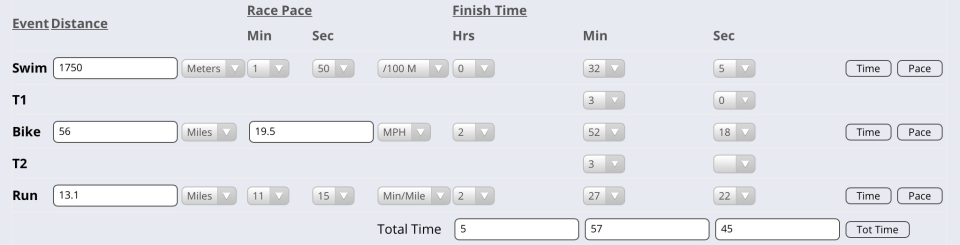


I finished the race in 6:02:14. I set a personal record shaving 17 minutes and 5 second off my best 70.3 finish. A sub six hour race is still teasingly close now.  My prerace goal was loafty, but almost got it accomplished.


13th of 28 in my division with the with 1st and 4th place
overall finishers coming out of my division.


SWIM

This swim was a washing machine with a 20mph wind that put a serious note to the swim.   Hint:  three marker bouys had already dislodged and pinned to the shore.  This swim (per race officials) was about 300 yard short and I don’t think any of the athletes were complaining.  I came out of the water toward the front of my swim group with a smile on Coach Ben’s face with the effort.
(8th place swim within division)

For my upcoming training:  Continue on the current path.  My swim is coming around and the distance is building.

BIKE

Before the race I noted: “I do NOT want to override this bike course.” I’m not sure that I overrode the bike course, but I rode the Hell out it.  I took every advantage of the course through techical bike skills. This was the the most wind that I’ve experience on any bike ride – seriously!  I was blown around like a small child in the crosswinds and buffeted by challenging headwinds.

What kind of ride was it? In the first 30 miles, I averaged 24.9mph and finished with a 20.2 mph average. Out with the wind for 30 miles and against the wind coming back.
(8th place bike within division)

Major Mistake:  I missed putting my electrolytes on my bike.   This was an oversight that made my pay dearly on the run.    My bike nutrition was on point (UCan liquid nutrition), but I only used water and had severe cramping coming off the bike due to electrolytes and muscle exertion.  I gave it all, but questionable whether it was too much.   70.3s simply hurt.

For my upcoming training:  Continue with the long bike ride and be sure to dial in an IM race pace both during training and during race.

RUN 

Before the race I noted: “Step over the finish line tired.”  YES, I stepped over the finish line tired. I came off the bike and stretched in transition.   I had cramped up taking my shoes off on the bike and knew that my electrolytes were out of wack – I hoped a good stretch would be enough.   I had a bottle of electrolytes waiting in transition – got some in my gut – and took the bottle with me.  

I wanted to push this run.   But, it wasn’t happening on a hot race day  (90 degrees). Every decision/mistake leading up to the run visited me on my run. I’m not sure that I had a muscle in my legs that didn’t cramp/quiver during the run. By mile 3, I knew that I would have to fight just to stay on a run. By mile five, an “easy run” pace was all that was possible without muscles starting to lock up. I poured electrolytes into my body with an effort to overcome 56 mile of inattention.  This inattention took it’s toll: At 9.67 miles, my left leg locked.  I got back on a slow run and found some relief at about mile 11 and I ended my attempt at a sub six hour 1/2 iron 400 yards from the finish line (2 minutes – yes, one length of the track)
(21st of 28th place with division)

For my upcoming training:  Run – nothing magic.  I feel comfortable were I’m at at this point of my training.   Continue to work toward to get faster over distances (long term)

NUTRITION

Before the race I noted: “This may be the biggest variable in the race. 95% of my nutritional plan is new.”

Nutrition was on point: GenerationUCAN.  The KMF team got me straight on this – one scoop every 30 minutes – perfect for what I needed it to do.  I did have some BASE salt added to the mixture.

Electrolytes suffered due to my prerace bottle preparation. Simply forgot to add it. Nuun 


Mentally

I was ready for a course that fought.  Predicted wind at 20mph plus prepared me for a tough swim and ride.  Unussually, I didn’t study my maps enoug prior to the race to know bike course elevations.    I was 200% prepared mentally for a 70.3.    During the course, there was a lot of  “self-talk” to determine:  tired | injured | painful | in-your head.  For the most part is was painful/can’t due to cramping rather that head problems (i.e, 9.67 lockup on run).

Done Right

Swim sighting was very good.  The bike was technically perfect for where I am now.   I got everything out of the bike that the course would give me.

Improvement

These remain from the last two race: Fitness and daily nutrition.   Need to be at race weight by next race in 60 days – said before – I’m getting there.  Improve my mangement of the race (mainly bike/run) – rather than pouring it all into bike.

My fitness is better since the last race and need to continue to progress during final eight weeks before IM Arizona – but I’m getting to Iron Fit.

Differently

  • One stupid electrolyte mistake cost me a lot.
  • Muscles need more resiliancy.  The cramping was surely a combination of muscle fatigue in addition to electrolyte imbalances.

I can remedy both problems.  Sometime the race is the race and 70.3 hurts.

Lessons

  • Full-iron distance is LESS scary from today’s viewpoint.
  • My swim sighting and lines are fine.  I lose time worrying about others.
  • Check and double check preparations.
  • Stay within the moment of the race and assess fuel gauges.
  • Carry salt and emergency electrolyte boosters in case of emergency.
  • No nutrition needed on the run.   No water bottle unless hot.

Back to Training

Continue to enjoy the training and race preparation process.

Next race

My “A” race is next.  It’s been a long season of races and preparation.   IRONMAN ARIZONA looms in the future.

Redman 70.3 (Part 1 – Pre-race)

Edmond,Oklahoma

June 25, 2017

I’m breaking this blog into Part I and Part II. Why? There’s a lot of “thinking that happens” during taper week of a race – a lot of race plans are finalized.

After the last race I stated: “Continue to trained harder and longer with more bricks – the long distance is fitness, fitness, fitness.  Full-iron distance is scary from today’s viewpoint.”

As I enter this race, I can say that the work has been done. Coach Ben worked, to make me feel better, by added extra brick workouts since the last race. My fitness is deeper and I’m progressing to the deep Ironman fitness/resiliancy.

Overall Race Plan

This is my third of three 70.3 races in preparation for Ironman Arizona 2017 (65 days). This race course will somewhat similar to the Arizona race in the elevations, wind and weather. The weather for this race, on Saturday, is the looking as if the course wants to put up a little bit of a fight. But a flat bike and run course will even the fight a little between the athlete and the course.

My training continues to progress and I’m certain that my swim, bike and run have improved mainly through deep fitness. This should mean that I can push the swim effort, stay steady on the bike, and manage/push? the run. I’ll repeat my overall race goals from the last race: I want to enjoy the race experience and collect good data for my next phase of training.   I don’t have pace/time goals per say.    BUT….what would make me happy?

SWIM

My post-race notes last race to help with this race: “Just swim.  To Hell with everyone else.  My sighting and lines are fine.  I lose time worrying about others.”

There’s a fine line between drafting of other swimmer and staying within your own swim. There are moment of opportunities that I need to take advantage of – as faster swimmers pass me on the course I need to get a little boost and hang on a hip for :30 to 60 sec.

Last Swim Time: 00:38:01. I would love to cut some time off of my last swim, but I’m expecting a chop and need to remember advice of short, fast strokes.

BIKE

Aerodynamic positioning. Staying in aero position will be important in this flat course with strong head and tailwinds. This type of course should be built for my size and power – this is an area of opportunity within the race.

Last Bike Time: 03:01:40. This flat course should provide me an opportunity to drop a few minutes off my last race. I do NOT want to override this bike course.

RUN

A 10:18 pace is an optimal pace for this race…..it teases me from afar. As much as I dream of this pace, an 11:15 is more likely as a TOP goal pace for this race. I do want to have a fast run than last race and inch a little closer to that 10:18. The pain is real. Step over the finish line tired.

Last Run Time: 2:30:50 

NUTRITION

This may be the biggest variable in the race. 95% of my nutritional plan is new. More about nutrition in Part II.

[END OF PART I}

Growing up in the dirt

Growing up is mud pies, cut fingers, skin’t knees and elbows. Growing up is scars that don’t go away – they tell your story.   Growing up is both a mangy dog and fleas in your favorite hand-me-down sleeping bag – you don’t mind, he’s a friend.   Growing up is your first view of the Pacific Ocean and first taste of lobster caught out of the back of the restaurant. Growing up is a sleeping on your favorite horse under the oak trees on a hot summer day – you don’t mind falling, you can get back up by way of the barb wire fence.   Growing up is a BB gun – hunting for song birds.   Growing up is your first shotgun – for crows and squirrels.   Growing up is lead shot is the bottom of the stew pan – and between your back teeth.   Growing up is your first teepee, log cabin, fuzz stick – with two matches. Growing up is your Boy Scout firem’n chit and tote’n chit – with the burns and cuts to show that you earned ‘em. Growing up is grasshoppers collected on the morning grass – next to the favorite fishing pond. Growing up is cane poles, a red and white cork, and a big grasshopper, that just clawed you – on the end of the line.   Growing up is a family img_9110camping trip in the back of an old Ford at a place a long ways away  (20 miles from your home).   Growing up is learning how to carve a ball captured in a piece of wood from an old man with a sharp knife – and him letting you help him with his.   Growing up is jumping quail and peeing your pant – just a little. Growing up is eating pears out of a pear tree – until you’re sick. Growing up is eating more pears out of a pear tree, the next day – until you’re sick.
Growing up is your first hunting lease and first deer. Growing up the first gun you have bought on your own.   Growing up is camping with a high school friend with shotgun propped against a tree and a rabbit on the fire.   Growing up is skipping school to go fishing. Growing up is skipping school to go hunting.   Growing up is simply taking time just to be.

Growing up is time watching your kids do the their own thing in their own way and realize amount of the time that your parents spent watching you experience your first of many times. It’s realizing that your parents truly understood the difference between good-for-you, good-for-you-might-get-you-hurt, and might-get-you-killed.   It’s realizing the fragile balance between a boy becoming a man a girl becoming a woman or simply being an adult.   It’s realizing that your parent’s decision to let you do was much harder than you actually doing it.

Growing up is a story, not a common adult story, but the story of building independence in people.   I watch my boys experience their first dirt, spit grit, and take another bite.   Dirt is more than dirt, there’s some true grit in there.

Transitioning from Gym Rat to Fighter (The Equipment)

The first step from gym rat (not a negative) to fighter is more than simply saying “I want to fight”.  In any boxing gym, a gym owner is more that willing to teach the skill of the sweet science to students and provide training for any and all participants.

A gym rat has equipment.  If you look inside their equipment bag, you will find a number of pieces of boxing equipment that marks them as a gym rat or boxer:

1) a manufacturer gym bag  – gotta show your colors
2) standard workout clothes.
3) a jump rope
4) boxing shoes
5) hand wraps (120″)
6) boxing gloves (for the heavy bag)

This list covers 90% of the activities covered in the gym workout.  There are, of course variations between parts of the country and the gym, but stripped down this will get you in any boxing gym to learn the sweet science.     This is the stopping point for some, but if they have some interest in boxing there are a few more pieces that they need to move to be a boxer:

7) mouthpiece (price is in ratio to protection):  Don’t skimp on quality.   Dental and oral surgery is expensive and worth protecting.  ShockDoctor makes a great array of mouth guards: https://www.shockdoctor.com/nano-3d-mouthguard

For the beginning boxer, most gyms have a collection of headgear that can be used for occasional sparring.   This is typically rugged use gear that get a lot of use on a weekly bases by the gym rats that want a little more to become boxers.  With this small amount of gear, anyone can learn the art of science of boxing and utilize the aerobic and anaerobic workout that is world famous for building a better body, better character and a person that has the ability to defend themselves.   Boxer don’t necessarily attend tournaments, fight in competitions or have e a fighting record.  Many boxer will go many years simply in the gym work on mitts, pounding heavy bags, attending classes and occasionally participating in gym sparring.

A fighter has different equipment that marks them as a fighter.   Every fighter knows the signs when someone get serious about the sport and want to learn the sweet science from inside the squared circle.

A fighter begins by investing in their own equipment.   I personally seldom loan my fighting equipment to others and then only to trusted fighters.   As a fighter, you trust your health and safety to the equipment that you wear in the ring and your longevity as a fighter depends on this equipment.

1)  Sparring Headgear – quality sparring headgear is between $100 – $150 and provide large protection to your head.   EVERY fighter has a different opinion of headgear, but here’s a few good examples:

http://www.ringside.com/ringside/ringside-deluxe-face-saver-boxing-headgear-8764.html

http://www.ringside.com/ringside/contender-fight-sports-palladium-no-contact-headgear-8743.html

http://www.shopeverlast.com/professional-sparring-head-gear.html

Each fighter has their preferences, and may absolutely hate the face saver style.  However, they have a great advantage of giving you more rounds in the ring while lessening the possibility of injury.   We can argue the advantages and disadvantages of full-face vs cheek protector vs open face for vision – protection ability favors full-face.

2)  Sparring Gloves (16oz/18oz/20oz) – quality in your dedicated sparring gloves (separate from bag gloves) is important for both your hands and for the welfare of your sparring partner.   Glove technology is changing at a rapid pace and there are many manufacturers that provide excellent gloves.   Ask yourself is your willing to have your partner use your old worn out gloves while sparring you.    Knots in laces, hanging string, worn covers and flattened protective filling are dangerous and distracting in a the learning environment of a sparring ring.

3)  Groin Protector – YES!

4) Shoes – Quality boxing shoes must be acquired.  Wear sliders or street shoes from the car to the gym and use boxing shoes exclusively within the gym.

5) Competition Uniform – Quality shorts, and jersey for amateurs,  that are professional and meet competition guidelines.   The night of a fight is no the time to be opening packages and popping tags.

6) Competition Headgear – Competition headgear is inherently lighter and not for everyday use.  I few sparring sessions to check fit – absolutely

And finally, use deodorant….

Hand up * Head down * Keep Moving!

Prof