The Flow
A couple of decades ago, GM Ernesto Presas (deceased) observed me and my favorite training partner during a seminar. We were training with machetes and sticks – when he walked by and remarked, “You are too strong.” I was a black belt with many years of experience. It was a passing comment, and when I asked him about it later, he didn’t have the English skills to explain further, but he repeated it twice more that weekend. GM Presas, having survived many life-threatening duels in the Southern Philippines, had my utmost respect. He gave a few clues, but I left the seminar with a puzzle to solve.
In the 1990s, martial arts resources were sparse. After additional weeks of training, I started analyzing my sessions. I videotaped my sparring, talked to mentors, and became hyper-aware of my techniques. One session, it clicked – GM Presas was right. I was too strong. My aggressive commitment to each combination left openings I hadn’t noticed. My commitment compromised my ability to recover and counterstrike. This was encapsulated in his brief statement: “…too strong.” This insight moved me from a plateau and opened a path for growth. When I saw him months later, he was pleased with my progress. “Slow is smooth, smooth is fast” became my guiding maxim.
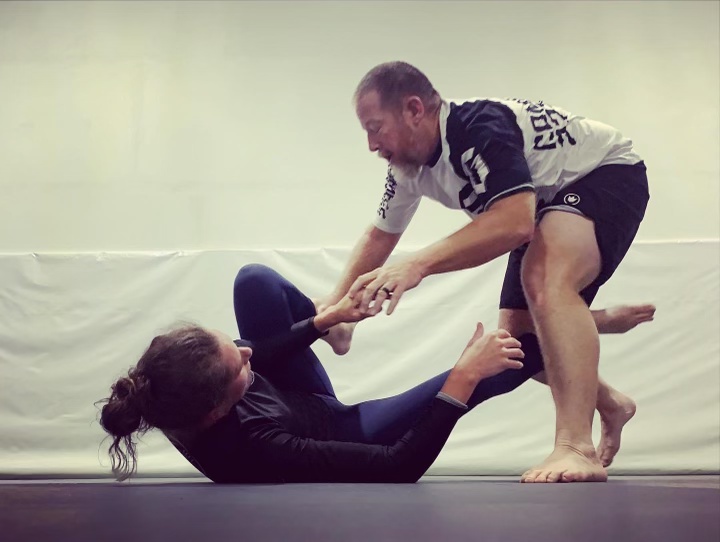
Fast forward a decade or two, I began training in jiu-jitsu. Initially, I did everything possible to get my opponent off or away from me, fully committing to each technique. It worked, but at a price. I’ve often heard “you’re strong” on the mats, but this compliment is double-edged. Strength in one direction is beneficial until you need to change direction. Strength is good until it’s not. It’s hard to change directions once strongly committed.
High-level athletes, especially in fighting arts, move fluidly despite their strength. A jab shouldn’t overextend because it’s needed for head defense. A tight hook keeps the elbow protecting the ribs. In jiu-jitsu, overextending a hip bump can lead to an easy back take for the opponent. Overextending a push leaves your arm unavailable to frame. A strong grip, if not abandoned at times, set you up for a triangle.
The flow is the ability to balance give and take—not too strong, not too weak. It’s about reading your opponent, setting traps, and escaping them. Overextension and poor positioning provide openings for your opponent to counter.
In Filipino martial arts, we start with the sumbrada, a choreographed dance of sticks. This beautiful drill trains us for free-flow sumbrada, where nothing is planned, but strikes and counters come fast and hard, with no time to think. “Slow is smooth, smooth is fast.” In jiu-jitsu, we have drills (a choreographed dance) and rolling (free-flow). Both involve working with partners to improve. We learn to flow. Strength is good if you can flow.
Sports psychologists describe the flow state, often called “being in the zone,” as when one is fully absorbed in an activity, losing track of time, and experiencing effortless concentration. It’s when one is so focused that everything else fades away, leading to peak performance and enjoyment.
I’ll suggest to you that if you haven’t found this state in your jiu-jitsu game, you are “too strong.”
—Don’t listen to blue belts,
Jeff

 Dr. Jeff M. Allen