
Current Research Areas
The following are research areas in which I have expertise. The overviews were generated with AI and are divided into the following sections:
- Wisdom
- Collective Wisdom
- Collective Intelligence: Human / AI
- Sensemaking
- Knowledge Management
- Workforce Innovation
Wisdom
Allen, J. (2023). Fostering Wisdom at Work. Rutledge Taylor & Francis Group. https//doi.org:10.4324/9781003018759 [Paperback]
Eaves, T., Allen, J., Rosellini, A., & Bank, N. (2023). Wisdom and Veterans: Enhancing the Perspective, Experience, and Resiliency of the Workforce. Journal of Information and Knowledge Management. 22(4), https://www.worldscientific.com/doi/10.1142/S0219649223500193.
Allen, J. M., Rosellini, A., Khader, M., & Njeri, M. (2022). Leveraging Collective Wisdom to Impact Workplace Culture. In T. Merlo (Ed.), Understanding, Implementing, and Evaluating Knowledge Management in Business Settings (pp. 106-130). IGI Global. https://doi.org/10.4018/978-1- 6684-4431-3.ch006
Rosellini, A., Allen, J. M., Khader, M., & Njeri, M. (2022). Work Tribes Present an Opportunity for Firms in Knowledge Management Systems. In T. Merlo (Ed.), Understanding, Implementing, and Evaluating Knowledge Management in Business Settings (pp. 58-82). IGI Global. https://doi.org/10.4018/978-1-6684-4431-3.ch004
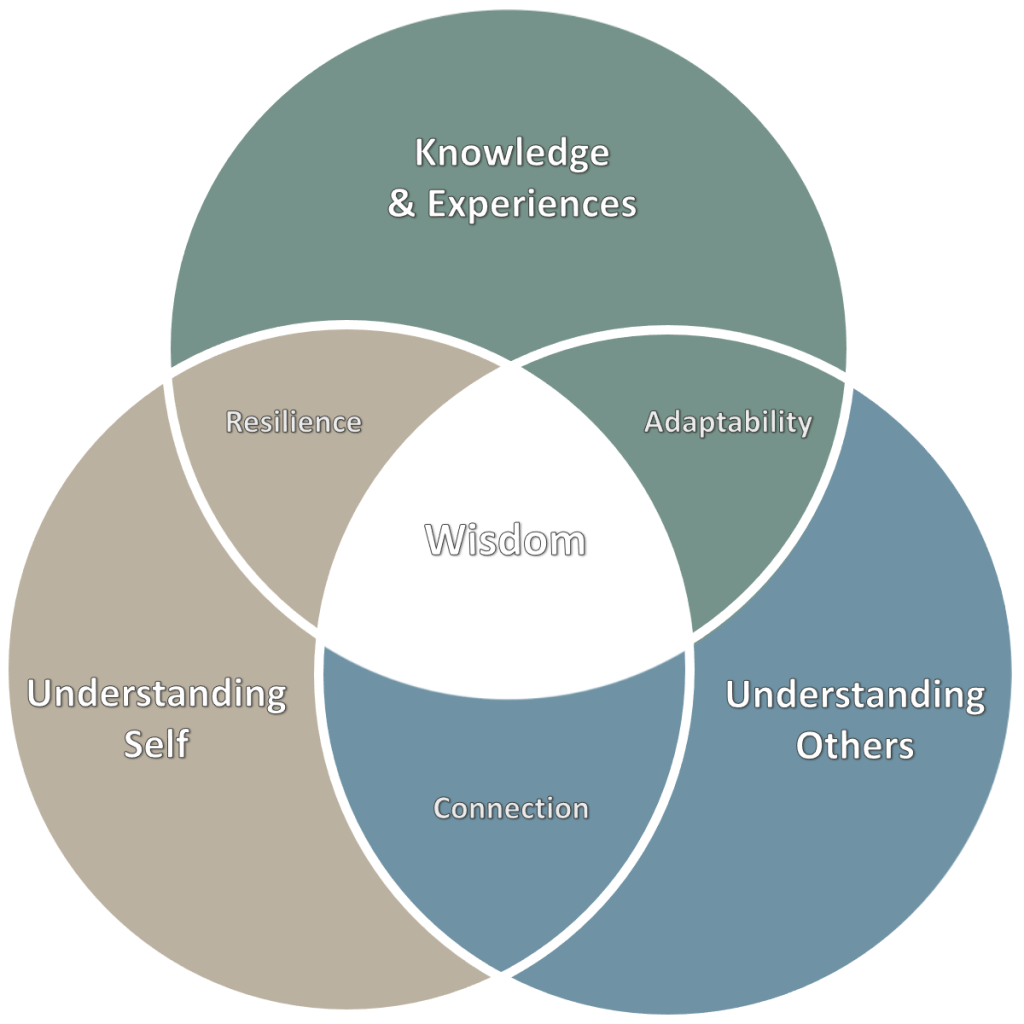
Wisdom is a complex and multifaceted concept that has been studied and debated by philosophers, theologians, and psychologists for centuries. It can be broadly defined as the ability to make sound judgments and take effective action in complex, uncertain, and changing situations. Wisdom is often considered to involve several key elements, including:
Cognitive abilities: Wisdom entails a deep understanding of the world, the capacity to view matters from multiple perspectives, and sound judgments grounded in knowledge and experience.
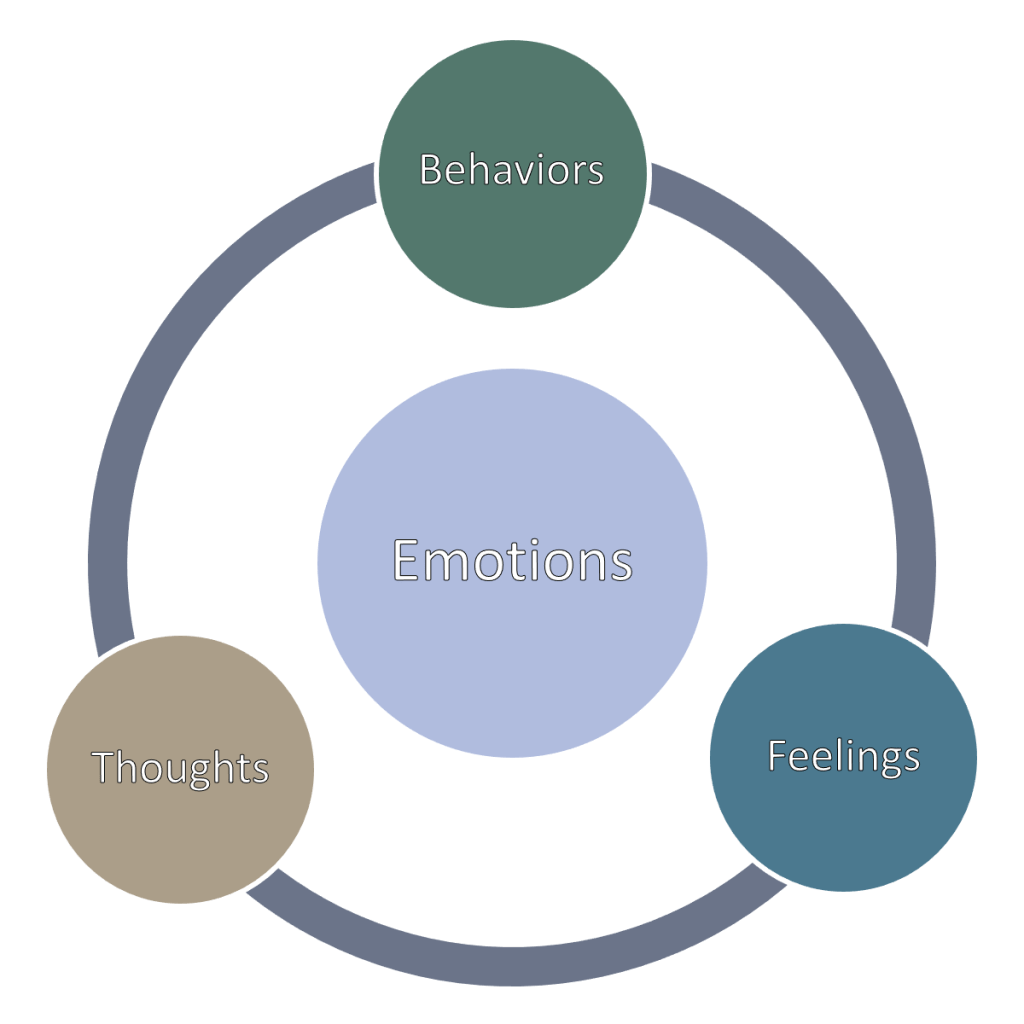
- Emotional regulation: Wisdom involves regulating one’s emotions and managing stress in difficult situations.
- Social awareness: Wisdom involves a deep understanding of human relationships, the ability to connect with others, and empathy.
- Pro-social behavior: Wisdom involves taking actions that benefit others, being selfless, and contributing to the common good.
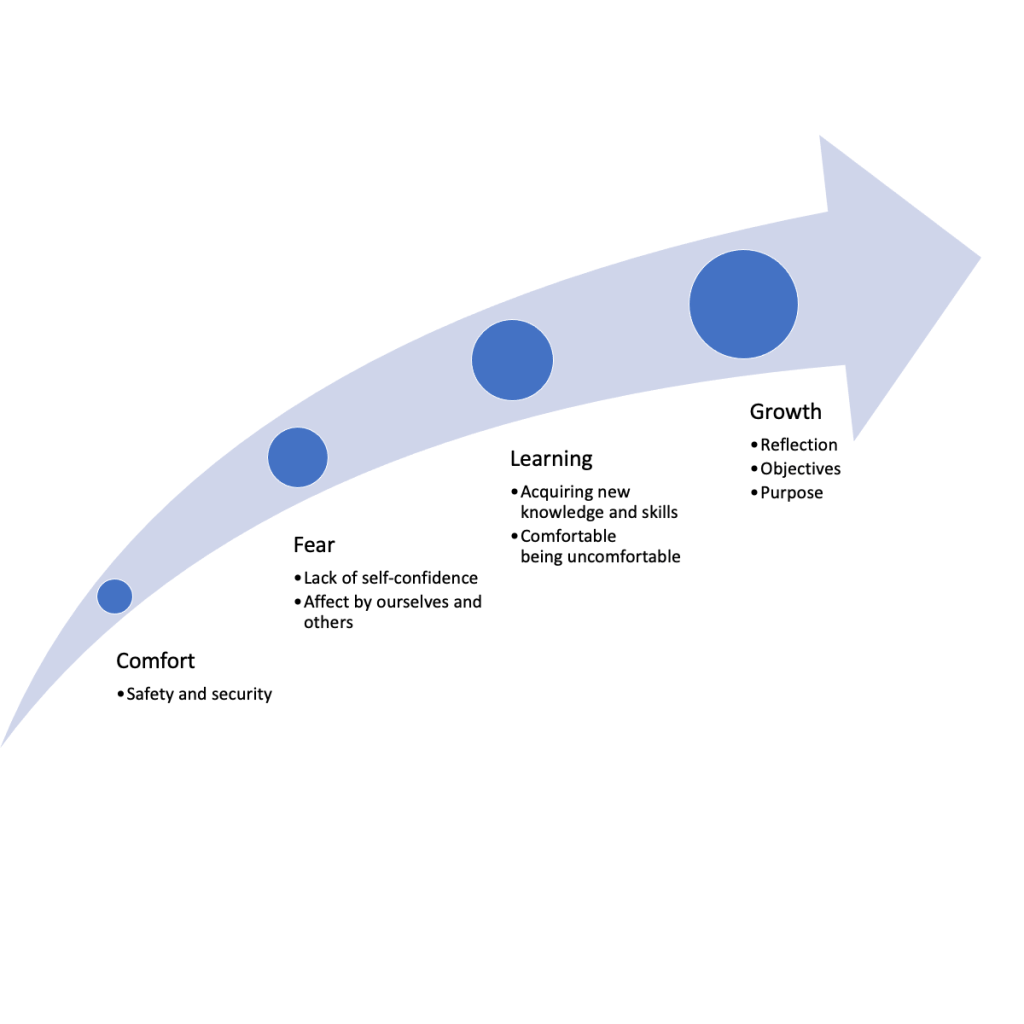
Wisdom can develop over time through a combination of life experiences, education, and reflection. Key factors contributing to the development of wisdom include intellectual curiosity, openness to new experiences, and the capacity to reflect on one’s experiences and learn from them. Wisdom has been linked to several positive outcomes, including better physical and mental health, stronger relationships, and greater life satisfaction. It is also associated with better decision-making, problem-solving, and effective leadership. Overall, wisdom is a valuable and highly sought-after quality that can bring numerous benefits to individuals and society as a whole. While it may be difficult to define, it can be cultivated and developed through a lifetime of learning and personal growth.
Collective Wisdom
Allen, J. M., Rosellini, A., Khader, M., & Njeri, M. (2022). Leveraging Collective Wisdom to Impact Workplace Culture. In T. Merlo (Ed.), Understanding, Implementing, and Evaluating Knowledge Management in Business Settings (pp. 106-130). IGI Global. https://doi.org/10.4018/978-1-6684-4431-3.ch006
Allen, J., Bracey, P., Aguilar, M., Zimmerman, T. (2020). Supporting Workforce Wisdom in a Global Economy. In C. Hughes (Eds.), Strategies for Attracting, Maintaining and Balancing a Mature Workforce (pp. 152 – 178). IGI Global. https://doi.org/10.4018/978-1-7998-2277-6.ch007
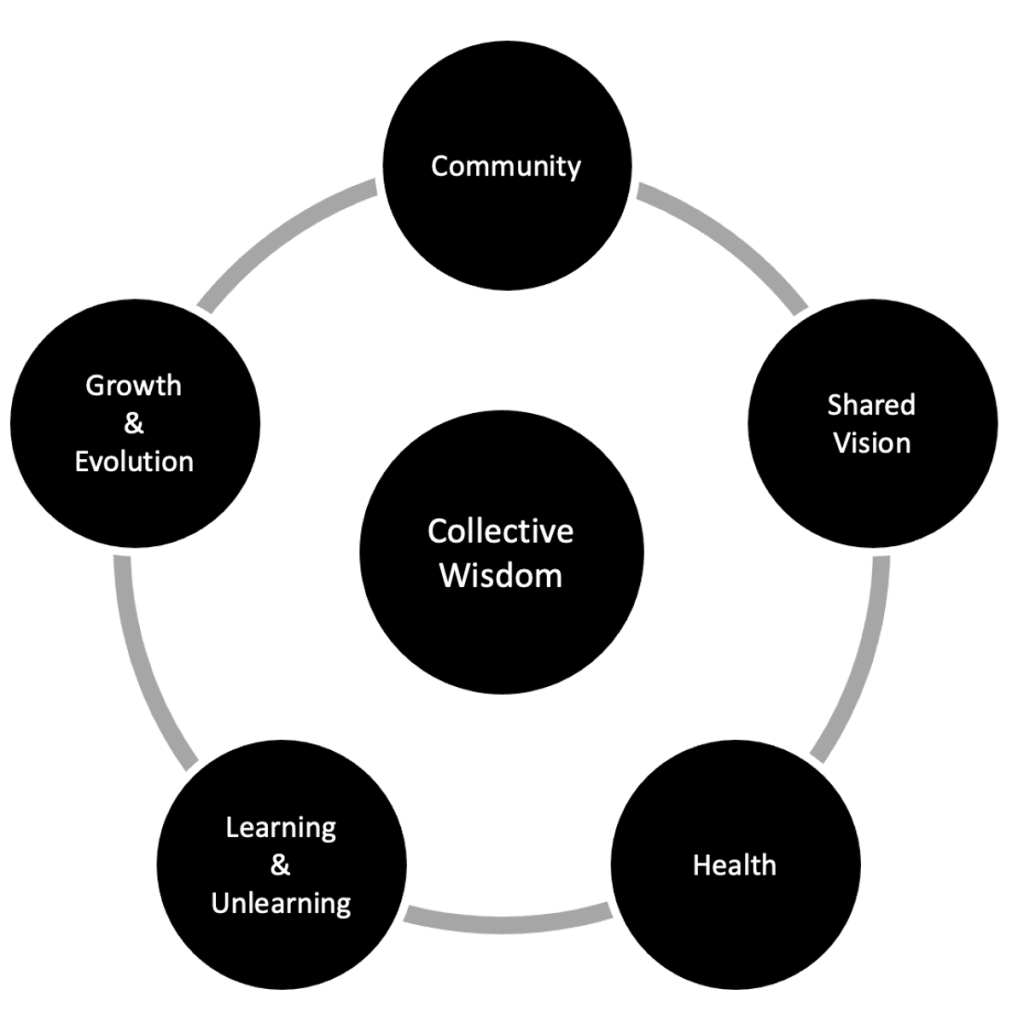
Collective wisdom refers to the knowledge, understanding, and insights that are generated and shared among a group of individuals. It is a concept that emphasizes that a group’s collective intelligence and knowledge can exceed the sum of its individual members’ intelligence and knowledge. The following are some key components of collective wisdom:
- Diversity of perspectives: Collective wisdom is built on the diversity of its members’ perspectives and experiences. By bringing together individuals with different backgrounds, experiences, and expertise, collective wisdom can draw on a broader range of knowledge and understanding.
- Collaboration: Collective wisdom requires communication and cooperation among group members, with each contributing their own knowledge and expertise.
- Facilitation: Collective wisdom is often facilitated by a leader or facilitator who helps to ensure that the group works effectively together and that the collective wisdom is shared and leveraged.
- Shared understanding: Collective wisdom requires group members to share the goals, values, and norms that guide their decision-making and problem-solving.
- Group decision-making: Collective wisdom often entails problem-solving, in which the group draws on its knowledge and expertise to make informed decisions.
Collective wisdom can confer many benefits, including improved decision-making, increased innovation, and enhanced problem-solving. It can also foster a sense of community and collaboration among group members. However, collective wisdom can also face challenges, including groupthink, unequal participation, and difficulty reaching consensus. Overall, collective wisdom is a powerful concept that recognizes the value of collaboration and the sharing of knowledge and expertise among groups. By leveraging the collective wisdom of a group, individuals and organizations can improve their decision-making, problem-solving ability, and overall effectiveness.
Collective Intelligence (Human-Centered AI)
Allen, J., Rosellini, A., Gavrilova, M., Whitson, T., Bracey, P. (In Press). Wisdom and Leadership: The Role of Collaborative Intelligence in an AI Era. In T. Merlo & P. de Sá Freire (Eds), Knowledge Management and Leadership in the AI Era: Harnessing Technology for Innovative Organizations. World Scientific. (Chapter 13)
Allen, J., +Whitson, T., & +Ghose, S. P. (2026, February 3). Collaborative intelligence: Partnership, not replacement. Information Matters. https://informationmatters.org/2026/02/collaborativez-intelligence-partnership
-not-replacement/
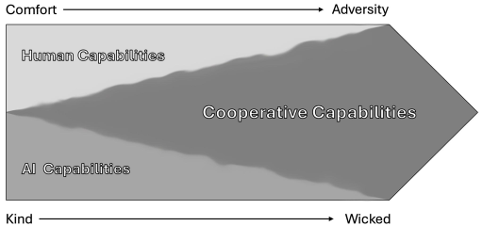
This fusion transcends traditional boundaries of teamwork, enabling humans and AI systems to coalesce their distinct strengths into robust hybrid systems. Central to this evolving domain is the concept of “collaborative intelligence,” which emphasizes a partnership in which humans and AI interact dynamically to solve complex problems, make decisions, and create innovations.
The unique value of this partnership lies in its complementary strengths. Humans bring contextual understanding, ethical judgment, and creativity, while AI contributes computational efficiency, pattern recognition, and scalability. This symbiosis enhances problem-solving capabilities across various domains, from healthcare diagnostics and financial modeling to scientific research and art.
A critical aspect of fostering effective human-AI collaboration is designing systems that enhance human agency and adapt to users’ needs and cognitive frameworks. This involves creating AI tools that are not merely passive assistants but active collaborators capable of learning from and responding to human input in real time. Transparent communication and mutual learning between humans and AI are paramount to cultivating trust and improving outcomes.
However, integrating AI into collective intelligence systems poses challenges. Ethical considerations, such as bias, accountability, and transparency in decision-making, remain pivotal concerns. Moreover, redefining organizational structures to accommodate hybrid human-AI teams requires new frameworks for training, evaluation, and governance.
The potential of collective intelligence lies in its ability to address increasingly complex global challenges. By aligning AI design with human values and enhancing the complementary nature of their partnership, the future of collective intelligence may not only improve efficiency but also generate insights and innovations unattainable by either entity alone. This emerging paradigm signifies a profound shift in how we approach collaboration, leveraging the strengths of both human intuition and artificial cognition.
Sensemaking
Turner, J., Allen, J., Hawamdeh, S., Mastanamma, G. (2023). The Multifaceted Sensemaking Theory: A Systematic Literature Review and Content Analysis on Sensemaking. Systems. 11(3):145. https://doi.org/10.3390/systems11030145
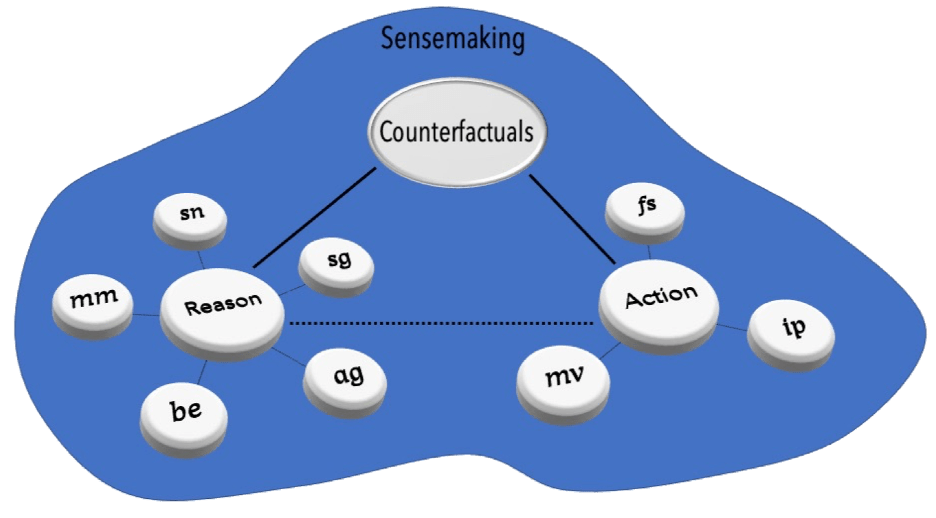
Sensemaking is the process of making sense of complex and ambiguous situations. It refers to the cognitive and social processes by which people understand, interpret, and make decisions in dynamic and unpredictable situations.
Sensemaking has its roots in organizational behavior, sociology, and psychology, and has been the focus of extensive research over the past few decades. This research has highlighted the importance of sensemaking across domains, including decision-making, organizational change, team sensemaking, and sensemaking in crisis situations. The process of sensemaking involves several key components, including:
- Gathering and processing information: Sensemaking begins with collecting data from multiple sources, including people, documents, and digital materials. The information is then processed and analyzed to identify patterns, trends, and relationships.
- Interpreting information: assigning meaning to collected and processed data. People draw on prior knowledge and experience, as well as the context in which the information is used, to interpret the data.
- Making decisions: Sensemaking is often employed in decision-making contexts, where people draw on the information and interpretations they have generated to make informed decisions.
- Reflecting and adjusting: Sensemaking is an iterative process, and people continually reflect on and adjust their understanding of a situation as new information becomes available.
In conclusion, sensemaking is a crucial process in many situations, particularly in complex and dynamic environments where traditional decision-making approaches may not be practical. Understanding and improving sensemaking processes can help individuals and organizations make better decisions and navigate challenging situations more effectively.
Knowledge Management
Rosellini, A., Allen, J. M., Khader, M., & Njeri, M. (2022). Work Tribes Present an Opportunity for Firms in Knowledge Management Systems. In T. Merlo (Ed.), Understanding, Implementing, and Evaluating Knowledge Management in Business Settings (pp. 58-82). IGI Global. https://doi.org/10.4018/978-1-6684-4431-3.ch004
Mayes, R., Tamez, R., Allen, J. (2017). Literature Overlaps and Gaps between the Fields of Knowledge Management and Human Resource Development. In D.G. Alumneh, J.M. Allen, S. Hawamdeh (Eds.), Knowledge Discovery and Data Design Innovation (pp. 265-281). World Scientific. https://doi.org/10.1142/10832
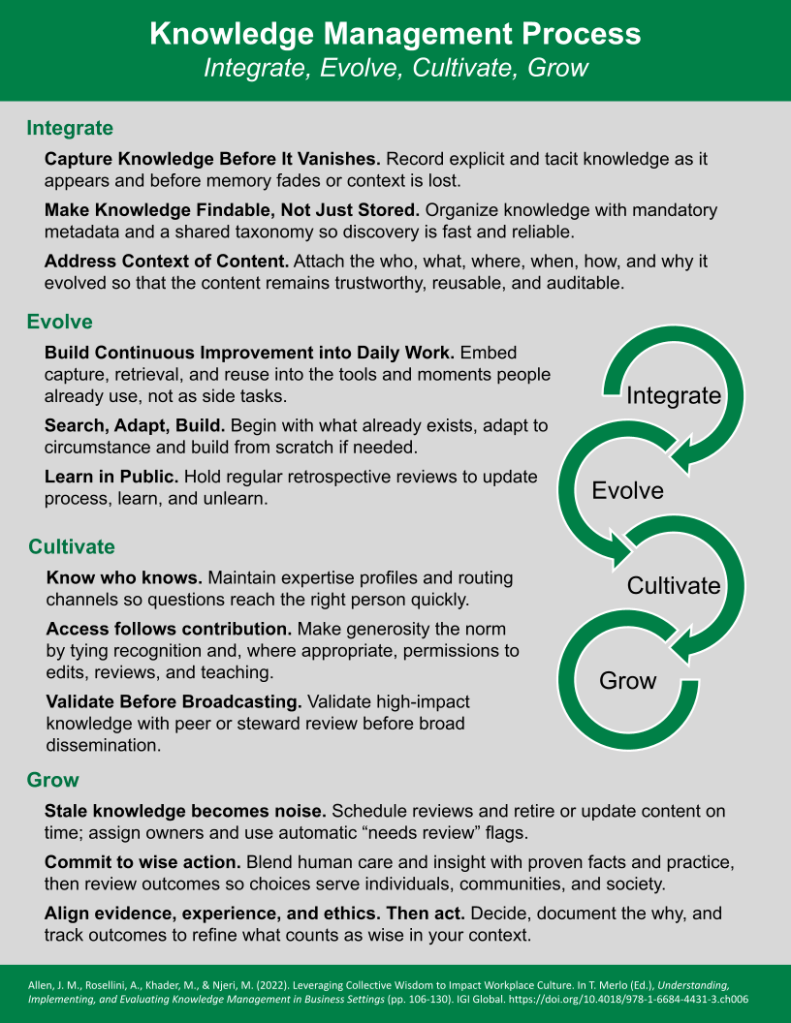
Knowledge management is the process of creating, sharing, using, and managing an organization’s knowledge and information. Its main objective is to enhance the organization’s efficiency and competitiveness by leveraging knowledge effectively. The following are some of the key components of knowledge management:
- Knowledge creation: generating new knowledge through research, innovation, and collaboration.
- Knowledge sharing: This involves fostering a culture that encourages collaboration and information sharing among employees and implementing technology to facilitate these processes.
- Knowledge utilization: This involves putting knowledge into practice, for example, by using it to improve decision-making, problem-solving, and innovation.
- Knowledge preservation: Ensuring that knowledge is stored and protected so that it remains readily accessible and usable in the future.
- There are various knowledge management models, including the explicit and tacit knowledge model, the knowledge conversion model, and the knowledge life cycle model. The choice of model will depend on the organization’s specific needs.
- To be successful, a knowledge management initiative requires strong leadership, a supportive culture, appropriate technology, and transparent processes and policies.
- Overall, effective knowledge management can bring numerous benefits to an organization, including improved decision-making, enhanced innovation, and increased organizational learning and memory.
Workforce Innovation
Rosellini, A., Allen, J. M., Khader, M., & Njeri, M. (2022). Work Tribes Present an Opportunity for Firms in Knowledge Management Systems. In T. Merlo (Ed.), Understanding, Implementing, and Evaluating Knowledge Management in Business Settings (pp. 58-82). IGI Global. https://doi.org/10.4018/978-1-6684-4431-3.ch004
Workforce innovation refers to the process of introducing new and creative ideas, practices, and technologies into the workplace to improve organizational performance and competitiveness. It can encompass a wide range of initiatives, including new product development, process improvements, organizational structure changes, and the adoption of new technologies.
The following are some key components of workforce innovation:
Employee involvement: Encouraging employees to contribute ideas and suggestions for improvement can foster a more innovative and engaged workforce.
Creativity and risk-taking: Encouraging employees to think creatively and embrace new ideas, even when they involve risk, can foster a culture of innovation.
Leadership and culture: A supportive leadership style and an organizational culture that values and encourages innovation can play a significant role in fostering an innovative workforce.
Technology adoption: The adoption of new and emerging technologies can significantly improve organizational performance and competitiveness.
Continuous improvement: Encouraging a continuous improvement mindset, in which employees identify areas for improvement and continuously test and refine new ideas, can lead to sustained innovation.
Workforce innovation can significantly impact organizational performance and competitiveness by improving efficiency, increasing productivity, and driving growth. It can also lead to a more engaged and motivated workforce, as employees feel valued and empowered to contribute to the organization’s success.
However, implementing workforce innovation can be challenging and requires a concerted effort from leadership, employees, and other stakeholders. It requires a culture that values and encourages innovation, and the adoption of best practices and technologies to support the innovation process.
Overall, workforce innovation is a crucial component of organizational success in the 21st century and requires a concerted effort from all stakeholders to foster a culture of innovation and to effectively implement new ideas and practices.
 Dr. Jeff M. Allen